
Copper Busbar Punching vs Laser Cutting: Choosing the Production Route
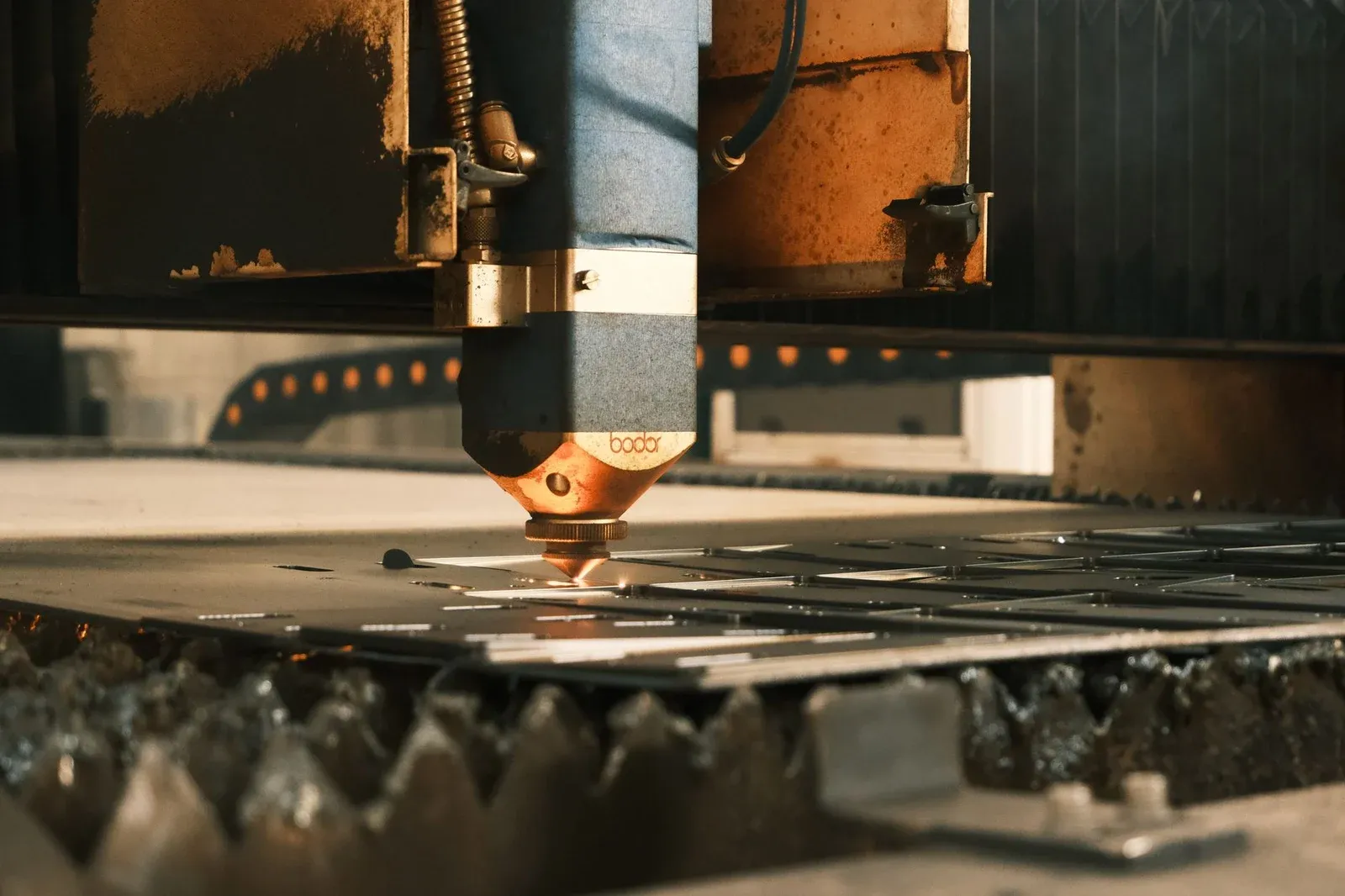
A flat bar with repeated round holes and a straight cutoff is a different manufacturing problem from a copper plate with an irregular outline and many changing cutouts. Comparing the two using only machine speed is unlikely to produce a useful purchasing decision.
Punching can be effective for repeatable feature families with suitable tooling. Laser cutting offers contour flexibility, but the copper-processing range and the finished edge still need to be proved. Either route can require cleaning, finishing, and secondary machining.
The comparison should end at an accepted busbar, not at the moment the tool leaves the material. The photograph shows a metal-cutting process; it is not evidence of a particular copper grade, thickness, or production rate.
Start With the Feature Family and the Stock Form
List the parts that actually drive the workload. Include material grade and condition, thickness, blank width, hole shapes, minimum features, overall contour, and the number of revisions expected during the project.
For standard holes repeated across many lengths of rolled flat bar, available punch tooling and automated feeding may provide a straightforward route. For changing contours cut from sheet, a laser may reduce the need for dedicated profile tools. Neither observation establishes the answer for a specific factory without its volumes and process constraints.
Separate holes from outlines. A part might have a simple outside shape but demanding terminal holes, or a complex outline with generous hole tolerances. The most complicated-looking feature is not always the one that controls acceptance cost.
Material purchasing also changes the comparison. Sheet nesting and flat-bar cutting create different remnants and handling requirements. Use actual material quotes and usable yield rather than assuming the two routes begin with equal-cost stock.
Compare What Each Process Leaves Behind
TRUMPF describes laser cutting as a contact-free thermal separation process. That explains its contour flexibility, but thermal processing still requires attention to the resulting edge and the particular material. Copper-cutting capability should be established for the proposed system, not inferred from its ability to cut steel.
SendCutSend’s copper material page is an example of a supplier defining a copper-processing offer with its own material and design conditions. Such conditions belong to that service; they should not be extrapolated into a universal machine limit.
| Decision factor | Punching and shearing | Laser cutting |
|---|---|---|
| Repeated standard holes | Can use established tools efficiently | Requires a qualified cutting path and feature capability |
| Changing free-form contours | May require special tools or another operation | Can offer contour flexibility within system limits |
| Edge condition | Check burr, rollover, deformation, and tool wear | Check dross, taper, surface effects, and thermal distortion |
| Stock handling | Often suits specified flat-bar families | Often suits sheet-based nesting and unloading |
| Changeover costs | Tool availability and setup matter | Programming, material setup, and process qualification matter |
Do not describe either process as inherently burr-free. The required busbar deburring and cleanliness route should be assessed with the part, including internal holes and protected contact faces.
For pre-plated material, verify how the operation affects the coating and exposed edges. For parts plated afterward, ensure that the prepared edge is suitable for the finishing specification.
Compare Accepted Parts, Not Cutting Speed
Use a cost model that includes setup, tooling, direct processing, handling, finishing, inspection, and expected nonconformance. Keep material consumption and scrap credit visible rather than burying them in a machine-hour rate.
A simple comparison is:
Accepted-part cost = relevant batch cost / number of accepted parts
Suppose, purely for illustration, route A has $600 of setup/tooling cost and $3 per accepted part for processing and finishing. Route B has $100 of setup and $7 per accepted part. Assume both achieve the same acceptance yield and that equal material cost is excluded from this limited comparison.
A = 600 + 3N
B = 100 + 7N
The arithmetic break-even is N = 125 parts. Below that quantity, B is cheaper under these assumptions; above it, A is cheaper. These are invented demonstration inputs, not quotations for punching or laser cutting.
The decision can reverse if one route needs additional hole finishing, has a different material yield, or produces more rejected parts. It can also change when tooling is already owned. Use the model to identify which real inputs need measurement, not to manufacture a universal batch-size rule.
Decide When a Mixed Route Earns Its Handling Cost
A mixed route can be sensible when one process produces the outline efficiently and another produces a critical feature reliably. But each transfer introduces another opportunity for identification errors, datum loss, surface damage, and queue time.
Define which operation establishes the primary datum and how it is preserved. If the second operation clamps on a thermally affected or distorted edge, the intended precision may not be achieved. Trial the complete sequence, including unloading and re-clamping, rather than showing two unrelated machine demonstrations.
Consider ownership as well as process capability. An outside laser-cutting service may be practical for low-volume contours while a dedicated in-house punch handles repeated terminal patterns. The commercial comparison then needs transport, order minimums, delivery variability, and the cost of resolving a rejected batch.
Avoid buying a second process merely to eliminate occasional subcontracting. Establish the part families and workload that would keep it useful.
Run a Trial That Resembles the Actual Order
Select drawings that expose the proposed route’s weaknesses: the smallest relevant hole, the narrowest ligament, the longest unsupported edge, a dense feature pattern, and any surface that must remain suitable for electrical contact.
Use the proposed material grade, temper, and coating condition. Measure not only feature position but also edge condition, flatness, distortion, and any characteristic important to downstream bending or assembly. Record the finishing and inspection time needed to obtain accepted parts.
Repeat enough of the trial to reveal setup and process variation. For punching, include tool condition and material support. Wilson Tool’s dedicated busbar tooling range illustrates why the tool application should be specified rather than assumed from nominal force alone.
Use a common inspection plan for both routes. If one sample is evaluated after finishing and the other immediately after cutting, the comparison is not like for like.
Put Equipment Boundaries in the RFQ
The DHCNC-BP-60 is a punching-and-shearing workstation. Evaluate it for the flat-bar dimensions, hole families, cutoff requirements, and production workflow agreed in the order. Do not treat it as a laser cutter or assume it can produce arbitrary sheet contours.
The separate punching-machine selection guide addresses force, tooling, and architecture once punching is the chosen route. Put the accepted-part trial and its records into the FAT/SAT agreement.
The better process is the one that consistently delivers the required busbar at the right total cost and capacity. Sometimes that is punching, sometimes laser cutting, and sometimes a qualified combination. The drawing and the evidence should decide.
Frequently Asked Questions (FAQs)
Is laser cutting always the cheaper choice for a small batch?
No. It can avoid dedicated contour tooling, but existing punch tools, stock form, setup, finishing, and outside-processing charges can change the result. Compare the cost of accepted parts for the actual batch.
Can laser power alone establish the copper thickness a machine can cut?
No. Copper capability depends on the complete laser system, process configuration, material, and required quality. Obtain the supplier's approved processing range and a representative trial.
Do laser-cut busbar holes always need a second operation?
No. A second operation is required only when the as-cut feature cannot meet the drawing or functional requirement. Assess hole geometry, edge condition, surface effects, and the intended joint.
Can a punching-and-shearing busbar machine perform laser cutting?
Not unless it is specifically designed and supplied with that capability. The DHCNC-BP-60 is a punching-and-shearing workstation, not a laser machine.
DHCNC-BP-60 CNC Punching & Shearing Workstation
Discover details, parameters, standard dies packages, and factory quotes.