
3-in-1 vs Separate Busbar Machines: Compare Cost per Accepted Panel
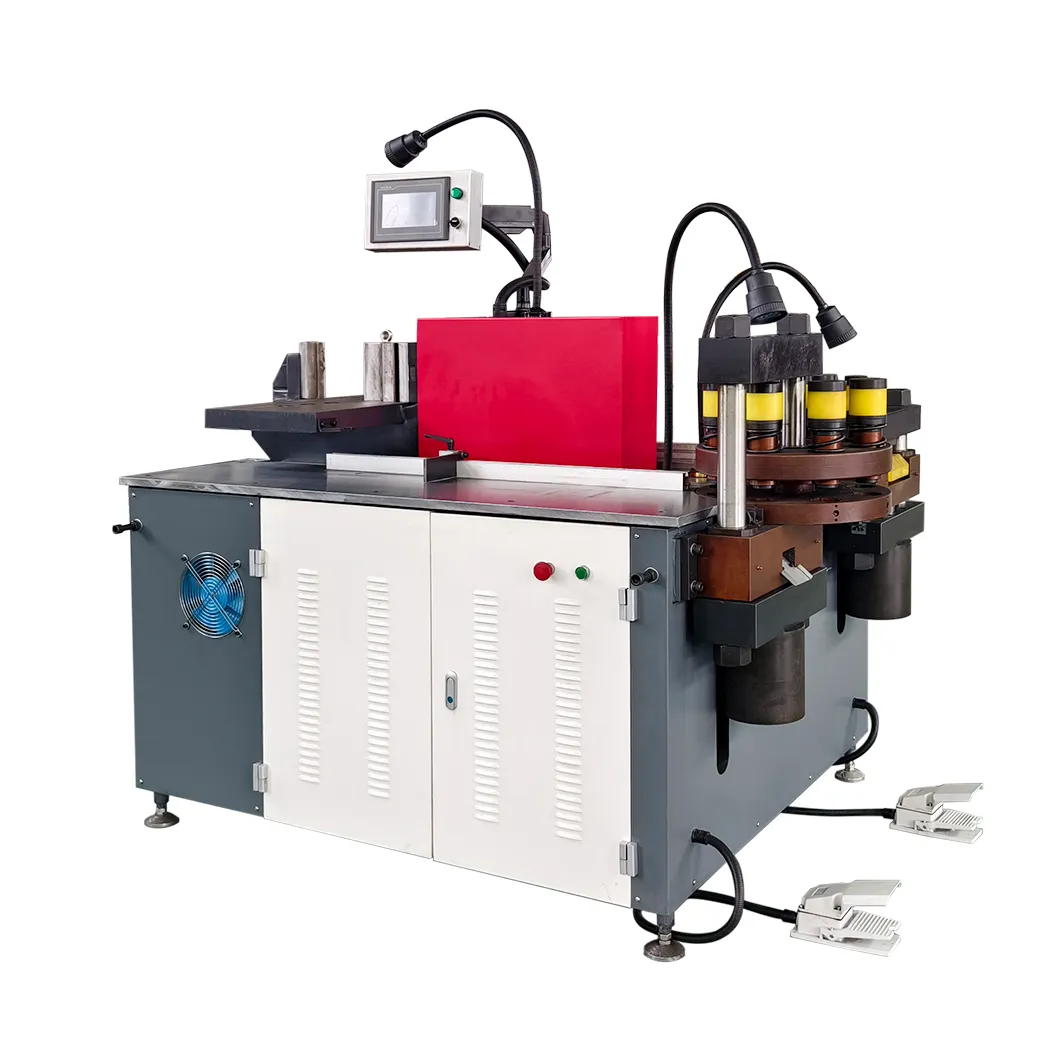
A 3-in-1 busbar machine and a line of separate punching, shearing and bending machines allocate work differently. The correct choice is not the one with the lowest purchase price or the highest quoted speed. It is the configuration that delivers accepted panels at the required rate with a cost and recovery burden the factory can sustain.
Build the comparison from your routed part families. Count complete work from released drawing to accepted busbar, including setup, movement, inspection and exceptions. A cost model based only on machine time will favor the more automated proposal without proving that the rest of the factory can use its output.
Compare the architecture before comparing price
| Decision factor | 3-in-1 workstation | Separate machines |
|---|---|---|
| Process layout | Punching, shearing and bending in one work area | Each process has an independent machine and queue |
| Parallel work | Depends on station design, staffing and shared resources | Different operations can run at the same time when staffed |
| Material movement | Fewer transfers between machines | Requires controlled transfer and staging between operations |
| Changeover | Mixed work may compete for tools, operators or setup attention | Each station can retain process-specific tooling |
| Floor and utilities | Compact installation and fewer machine connections | More floor space, foundations, power and service points |
| Failure impact | One unavailable workstation can affect several operations | A failed machine stops its process but other stations may continue |
| Production control | Short physical route, often managed locally | Strong job, revision and status control is required at each handoff |
The automation-level guide addresses which tasks remain manual or programmed. Keep that question separate from architecture: a 3-in-1 machine may have programmed functions, and a line of separate machines may still rely heavily on manual loading and transfer.
Calculate cost per accepted panel
Use one period and one definition across both proposals:
Cost per accepted panel = total relevant monthly cost ÷ accepted panels released
Build the numerator from auditable cost buckets.
| Cost bucket | What to include | Evidence to collect |
|---|---|---|
| Ownership | Lease or depreciation basis, finance, required accessories | Quotation, finance terms and accounting method |
| Direct labor | Programming, setup, loading, processing, transfer and normal inspection | Routed time study by role |
| Material loss | Offcuts that cannot be reused, setup pieces and rejected parts | Material reconciliation by grade and section |
| Tooling and maintenance | Dies, blades, lubricants, planned service and critical spares | Tool-life record and maintenance plan |
| Changeover and waiting | Tool changes, first-piece approval, blocked queues and starvation | Timestamped batch observations |
| Downtime and recovery | Diagnosis, restart, discarded interrupted parts and external support | Alarm and maintenance history or witnessed recovery test |
| Facility | Occupied floor area, handling space, power, foundations and extraction | Approved layout and utility schedule |
Do not count the same loss twice. For example, operator hours during a tool change belong in direct labor; the lost capacity matters separately only when it causes overtime, delayed orders or additional equipment.
Use accepted output in the denominator. A faster cycle that creates more work-in-process or inspection rejects does not reduce cost per released panel.
Expose contention around a 3-in-1 workstation
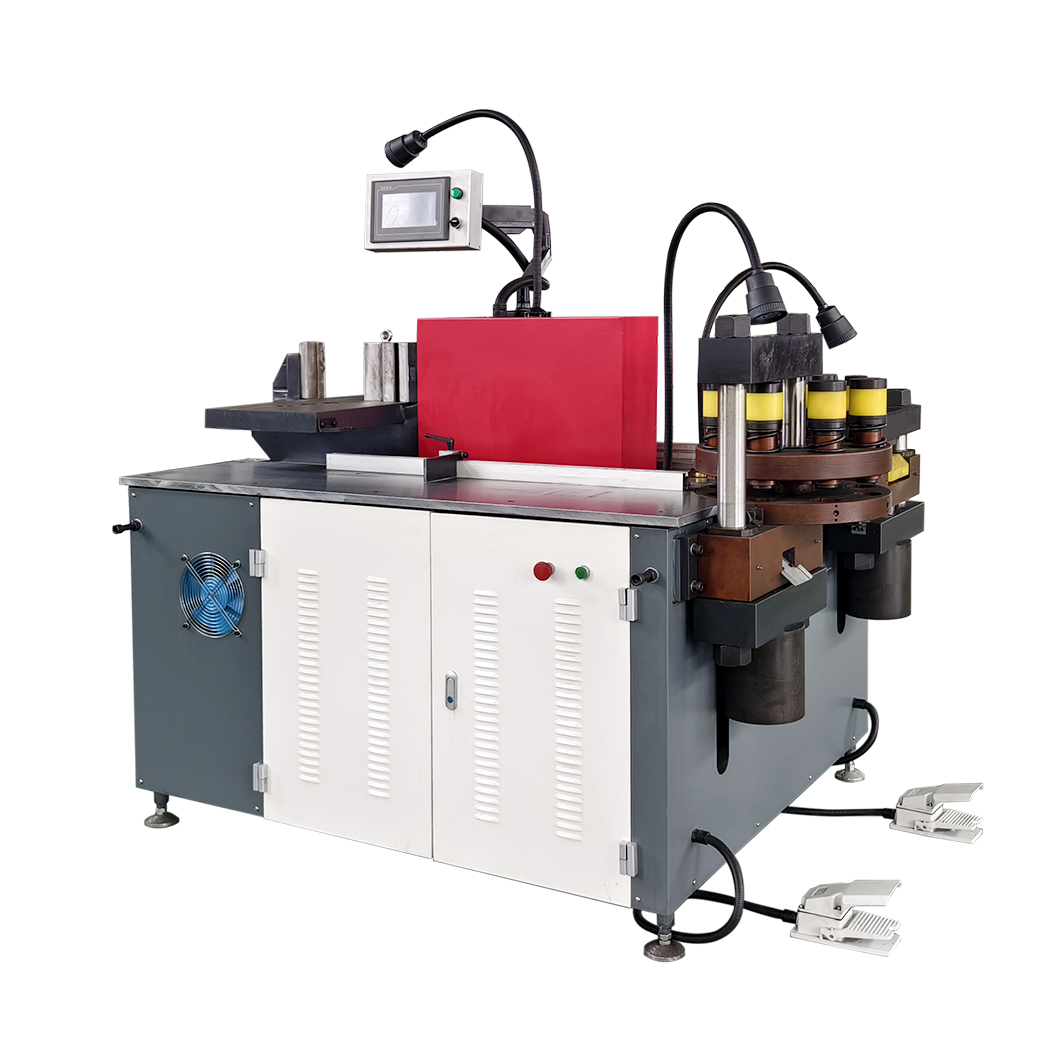
The DH303-8P has separate punching, shearing and bending stations with three independent hydraulic circuits. That makes different operations available at the same time, but it does not by itself prove three productive streams.
Check who loads and unloads each station, whether material paths interfere, which tools and measuring devices are shared, and whether one inspector releases all first pieces. Record queue time as well as powered cycle time. A compact workstation is most valuable when its physical simplicity removes more transfer and coordination time than the shared area creates.
Count the handoffs between separate machines
A dedicated CNC punching and shearing machine paired with a CNC bending machine can let punching and bending proceed in parallel. This arrangement may also allow each station to retain specialized tooling.
The saving is not automatic. Every transfer needs a defined container or rack, part identity, drawing and program revision, quantity, inspection state and destination. Include travel and staging in the trial. If the bending station waits for punched blanks or the inspection station blocks both machines, nominal parallel capacity will not become accepted output.
Use an incremental break-even equation
Compare the additional fixed cost of the separate-machine option with its verified variable saving:
Break-even accepted panels per month = additional monthly fixed cost ÷ variable saving per accepted panel
For an illustrative calculation only, suppose separate machines add $750 per month of ownership and facility cost, while witnessed trials show a $10 saving per accepted panel in labor, material loss and recoverable downtime. The arithmetic break-even is 75 accepted panels per month.
At 50 panels, the variable saving is $500 and does not cover the added $750. At 100 panels, the saving is $1,000, leaving a $250 monthly advantage before tax and financing effects. These figures are not a production benchmark: replace currency, wages, shifts, cost of capital, material yield and service cost with plant data.
The equation is only an economic screen. Confirm that both configurations can meet peak demand through a route-and-capacity model. The cycle-time and OEE method shows how to include changeovers, availability, performance, quality and shared constraints.
Test normal, peak and exception batches
Use the same controlled drawing set and material for both proposals. Include:
- a normal family that represents routine volume;
- a peak part with the greatest routed load or most demanding geometry;
- an exception batch with a drawing change, unusual tool or interrupted cycle;
- at least one changeover that affects both punching and bending;
- first-piece approval and normal in-process checks;
- a witnessed stop, diagnosis and safe restart.
Record raw timestamps, operator count, accepted quantity, rejects, reusable remnants and every manual intervention. Do not convert a dry run or a single operation into panel output. Preserve the trial conditions with the result so procurement can distinguish an observation from an assumption.
Include resilience and staged expansion
Separate machines can isolate a process failure, but they also add controls, spares, service points and dependencies. A 3-in-1 workstation simplifies the installed base, but an extended outage can remove several operations together. Price the recovery plan, not just the normal cycle.
A staged layout may be the lowest-risk answer. A factory can retain a 3-in-1 workstation for mixed work and add a dedicated machine at the measured bottleneck. The original workstation may then handle prototypes, rework or overflow, provided those uses are included in the load plan rather than treated as free capacity.
Upgrade when evidence shows all three conditions:
- demand repeatedly exceeds the current route’s effective capacity;
- the added resource removes the measured constraint rather than moving it downstream;
- verified variable savings and delivery value cover the added fixed and support cost under a conservative scenario.
Turn the comparison into acceptance requirements
In the RFQ, name the routed parts, batch sizes, material, operators, included tools, inspection points and start/finish boundaries. Require each supplier to state what is automatic, what remains manual and what is excluded. Use the same cost worksheet and FAT evidence for every option.
The best architecture is the one whose complete route remains economical in the normal case, delivers the peak case and recovers from the exception case. Send representative drawings through the custom machine assessment to compare configurations against measurable parts rather than marketing labels.
Frequently Asked Questions (FAQs)
What is the main difference between a 3-in-1 busbar machine and separate machines?
A 3-in-1 machine keeps punching, shearing and bending in one compact work area. Separate machines assign operations to independent resources, which can support parallel flow but add transfers, floor space and production-control handoffs.
Are separate busbar machines always cheaper per panel?
No. Separate machines can reduce waiting and changeover losses when demand uses their parallel capacity. At lower utilization, their additional ownership, floor-space and service costs may outweigh the variable savings. Use accepted panels and complete routed labor in the comparison.
How do you calculate the break-even volume for separate machines?
Divide their additional monthly fixed cost by the verified variable saving per accepted panel. Then confirm that the proposed system has enough capacity at the calculated volume and test the assumptions with representative batches.
What should a supplier prove during FAT?
Run normal, peak and exception batches through the offered route. Record setup, loading, processing, transfers, inspection, recovery, good output, scrap and operator time. Compare the evidence with the same definitions used in the cost model.
DH303-8P 3-in-1 CNC Busbar Processing Machine
Discover details, parameters, standard dies packages, and factory quotes.