
Data Center Switchgear Planning: Busbar Design, Capacity, and Procurement
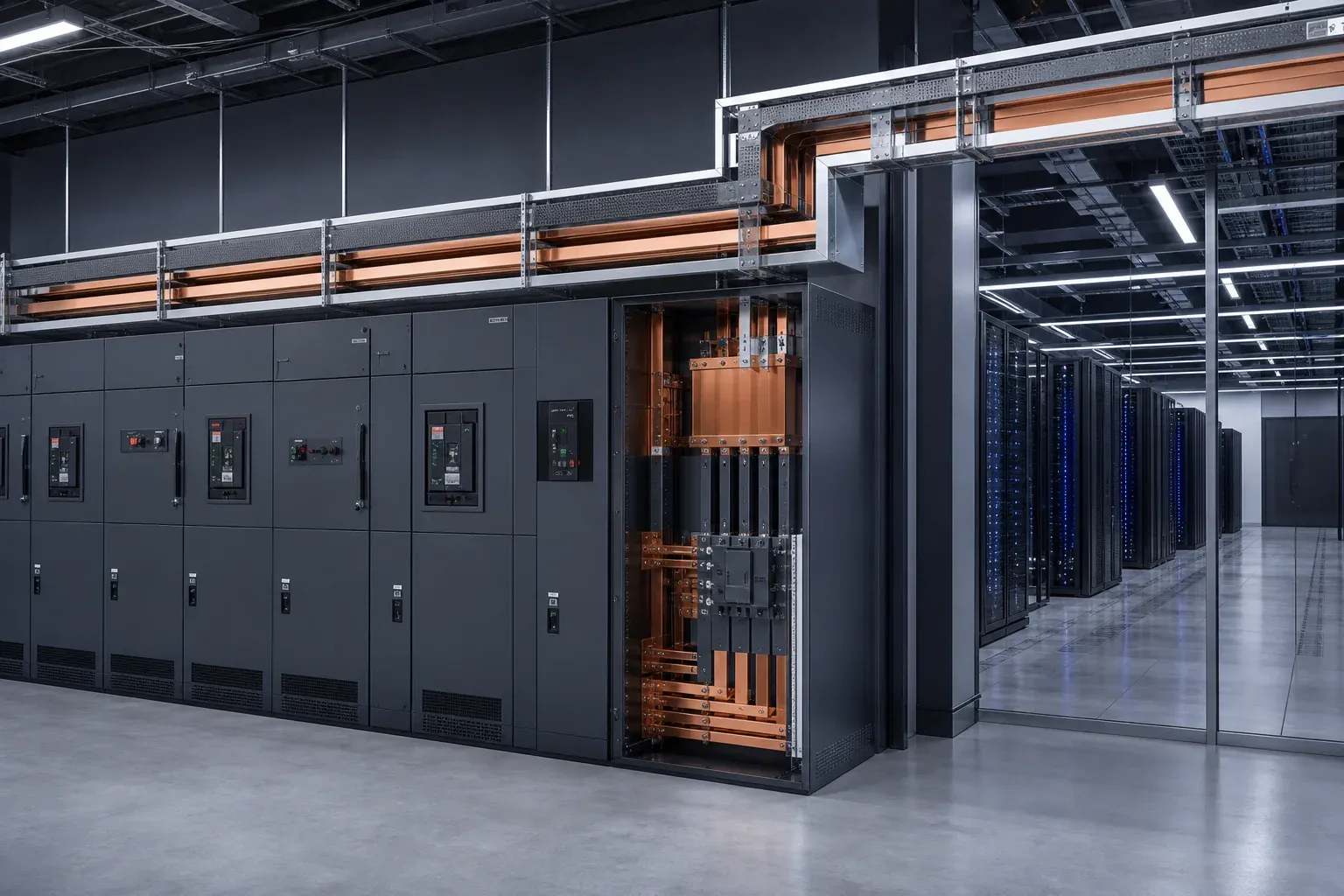
Data center switchgear should be procured from an electrical architecture, not from a cabinet count. AI load growth, phased expansion, maintenance states, utility constraints, and alternate-source arrangements can change the current path long after a preliminary one-line is drawn. Those changes eventually reach the busbar package as new section ratings, tie configurations, hole patterns, joints, and delivery priorities.
The purpose of the procurement plan is to stabilize those inputs early enough for design verification and manufacturing, while preserving controlled options for expansion. A supplier’s nameplate catalogue and a promised ship date are not enough.
Freeze the Architecture Before Requesting Comparable Quotes
At RFQ release, the buyer should define the facility boundary and the operating states the equipment must support. Include utility and on-site sources, transformers, generators or other backup, UPS topology, maintenance bypasses, tie breakers, load blocks, and future modules. Mark which portions are fixed and which are alternatives.
The Congressional Research Service report on electricity demand from data centers, updated in May 2026, describes the policy and grid-planning context behind rapidly changing US data center loads. It does not specify a switchgear design. Project teams still need site-specific load-flow, short-circuit, coordination, grounding, and reliability studies.
A useful basis-of-design package includes:
- normal, emergency, maintenance, and expansion one-lines;
- voltage, frequency, phases, wires, and grounding;
- present load, committed expansion, and design reserve;
- available fault current and protective-device strategy;
- redundancy objective and allowed maintenance outages;
- room conditions, altitude, ventilation, access, and seismic requirements;
- equipment classification and destination-market standards;
- interfaces to transformers, UPS, busway, cables, and controls.
Without that package, vendors price different systems under the same label.
Translate Facility Priorities Into Busbar Inputs
| Facility requirement | Busbar implication | Evidence to request |
|---|---|---|
| Continuous load and growth | conductor arrangement and thermal design | calculations or verification allocated by the assembly design |
| Available fault current | support spacing, joint and conductor-force design | short-circuit verification basis |
| Redundant sources and ties | multiple credible current paths | operating-state study and section ratings |
| Maintainability | accessible joints, isolation boundaries, replaceable sections | layout and maintenance procedure |
| Monitoring | sensor locations and safe access | interface drawing and calibration plan |
| Phased deployment | repeatable modules and controlled revisions | configuration matrix and change log |
The conductor cross-section cannot be selected independently from enclosure ventilation, supports, adjacent heat sources, joints, and permitted temperature rise. Likewise, short-circuit withstand is an assembly property; using thick copper does not prove that supports and joints can withstand electromagnetic forces.
Separate Switchgear, Switchboard, and Busway Work Packages
These terms describe different equipment and responsibilities. The RFQ should show where switchgear or switchboard terminals end, where busway begins, who supplies transition pieces, and who owns interface tolerances and site measurements.
For a North American dead-front switchboard, the UL 891 fabrication guide explains why equipment classification precedes copper release. For IEC assemblies, IEC 61439-1:2020 provides the general-rules context. Neither route should be selected by casually changing the terminology in a purchase order.
The existing 1500 VDC data center busway guide addresses the facility-side conductor system. This article keeps the switchgear work package separate so both pages answer a distinct procurement task.
Evaluate Fabrication Capacity, Not Only Nameplate Ratings
A switchgear design can be valid while its production plan is fragile. Buyers should map the planned copper parts into families: straight punched bars, complex bends, joint plates, neutral and ground conductors, transition pieces, and repeated module sets. Then ask how the supplier will schedule the bottleneck operations.
Capacity evidence should address material size range, punching and shearing, bend types, deburring, finish, first-piece inspection, program control, and handling between operations. It should also show what happens when a drawing changes after the first batch.
For repeat parts, a controlled CNC busbar punching and shearing workstation can reduce manual layout variation. Buyers still need a trial using their material and drawing; catalogue speed is not the same as finished-part throughput.
Make Verification and Traceability Deliverables Part of the RFQ
Do not wait until shipment to ask for quality records. Define the deliverable matrix with the bid:
- approved one-line, assembly drawings, busbar drawings, and revision list;
- material specifications and required certificates;
- first-piece and dimensional reports for critical parts;
- joint assembly, finish, insulation, and torque procedures as allocated;
- design-verification and routine-verification documents required by the project;
- measuring-equipment and test-report identification;
- nonconformance, concession, and engineering-change records;
- packing, preservation, installation, and commissioning documents.
The matrix should state who creates, reviews, and approves each record. A generic certificate bundle does not replace project traceability.
Plan Lead-Time and Design-Change Risk by Dependency
Break the schedule into approved drawings, long-lead protective devices, transformer interfaces, copper and steel, busbar fabrication, assembly, verification, shipment, room readiness, and commissioning. Each dependency needs a required-by date and an owner.
Modularization can help when it reduces unique parts and stabilizes interfaces. It hurts when a “standard” section is repeatedly modified after validation. Establish a design-freeze process with defined classes of change: documentation-only, manufacturing change, interface change, and change requiring engineering or certification review.
The transformer-shortage capacity guide addresses one upstream risk. The broader hyperscale fabrication article covers capacity strategy beyond the switchgear package.
Prepare Interfaces for Emerging 800 VDC Architectures
NVIDIA’s published 800 VDC architecture and the Open Compute Project’s LVDC power-distribution white paper have increased attention on higher-voltage DC distribution closer to high-density AI racks. This does not mean every current data center switchgear RFQ should be converted to 800 VDC. It means the team should define the AC/DC conversion boundary, row-power equipment, protection ownership, busway interfaces, isolation, monitoring, and maintenance model before reserving space or terminals.
The dedicated 800 VDC data center architecture guide separates published roadmap statements from current project requirements.
Use a Procurement Scorecard That Exposes Risk
| Scorecard area | What a credible response contains |
|---|---|
| Technical fit | deviations against a frozen basis of design |
| Verification | named standard route and evidence matrix |
| Fabrication | part-family capacity, trial plan, inspection method |
| Schedule | dependency-level dates and buyer inputs |
| Change control | authority, notification, re-verification triggers |
| Installation | interface checks, site utilities, commissioning plan |
| Service | training, spares, backups, response path |
Weight the categories for the project rather than awarding the order to the lowest cabinet price. For switchgear panel busbar production, the strongest proposal is the one that makes design boundaries, capacity evidence, and change responsibility visible before manufacturing starts.
Frequently Asked Questions (FAQs)
What information is needed before a data center switchgear RFQ?
Define the one-line architecture, voltage and grounding, present and future load blocks, redundancy, available fault current, protection concept, equipment classification, installation environment, interface drawings, verification requirements, delivery milestones, and change authority.
How does redundancy affect switchgear busbar design?
Redundancy can add tie sections, alternate sources, maintenance states, and load-transfer combinations. Each credible operating state must be included in current, fault, protection, and thermal studies rather than assuming the normal one-line is the worst case.
What is the difference between switchgear, switchboards, and busway in a data center?
Switchgear and switchboards contain switching, protection, and distribution functions under different equipment classifications. Busway is an enclosed conductor system used to carry and distribute power between equipment. Their interfaces and applicable standards should be defined explicitly.
Which busbar fabrication records should a buyer request?
Request released drawing and material revision, material identity, first-piece and dimensional results, contact-surface and finish records, nonconformance disposition, change history, and the project-specific assembly verification documents allocated to the supplier.
How should buyers evaluate switchgear lead-time risk?
Break lead time into approved drawings, long-lead components, copper and steel, busbar fabrication, assembly, verification, shipping, and site readiness. Assign an owner and freeze date to each dependency instead of relying on one quoted delivery number.
DHCNC-BP-60 CNC Punching & Shearing Workstation
Discover details, parameters, standard dies packages, and factory quotes.