
How to Specify Busbar Thickness for Switchgear—and Select the Right Machine
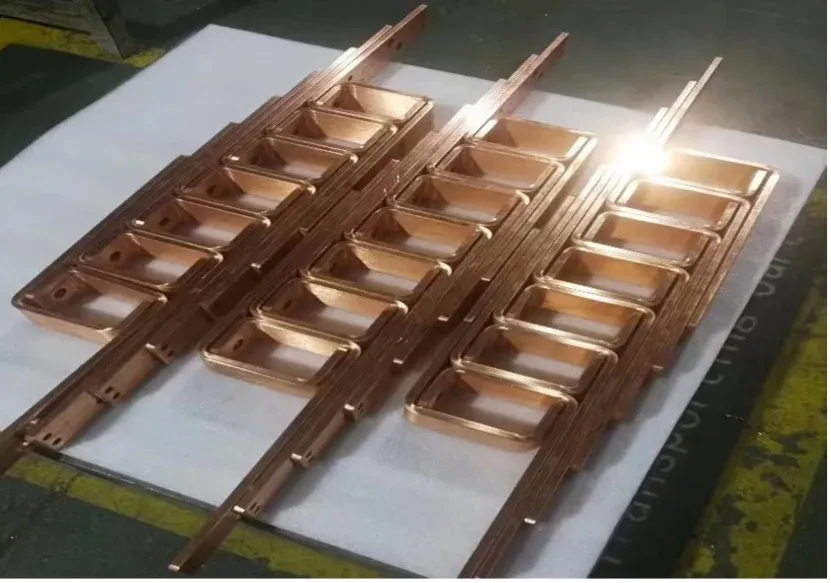
Busbar thickness is an electrical and mechanical design output—not a value that should be selected from a generic ampacity table or from a machine brochure. The approved section must satisfy the switchgear assembly’s temperature-rise, short-circuit, insulation, support and installation requirements. Only after that design is defined should the factory select equipment for punching, shearing and bending the specified parts.
This separation prevents two common errors: treating a sample current table as product verification, and assuming that a machine’s headline maximum thickness proves every hole and bend on the drawing.
Define the busbar before selecting equipment
Give the machinery supplier a controlled part-family matrix. At minimum, include:
| Design input | Why it matters to fabrication |
|---|---|
| Material grade, temper and coating | Changes punching force, springback, edge condition and surface-protection needs |
| Width and thickness range | Establishes the basic working envelope |
| Hole and slot geometry | Determines punching perimeter, tool stations and edge-distance checks |
| Bend angle, inside radius and direction | Determines force, tooling and crack or interference risk |
| Minimum flange and hole-to-bend distance | Reveals whether the part can be supported and accessed by the tool |
| Datum scheme and tolerances | Defines the program origin and inspection method |
| Batch size and part mix | Affects changeover, throughput and cell architecture |
Do not send only the largest rectangular bar. Include the most demanding hole, shortest flange, tightest offset and any plated or insulated surface.
Keep electrical sizing with the design authority
Two bars with the same cross-sectional area can behave differently in an assembly because width, thickness, orientation, spacing, enclosure conditions and joints affect heat transfer and current distribution. Parallel conductors also require a controlled arrangement; simply multiplying the area does not prove equal current sharing.
The responsible designer should document the material, conductor arrangement, connection system, support spacing, ambient assumptions and applicable verification route. Holes, slots and formed regions may change the local section or current path and must be addressed in the approved design.
Machine suppliers can provide fabricated samples and dimensional evidence. They should not assign the switchgear current rating or claim product compliance from bar thickness alone.
Check punching and shearing capacity by feature
Maximum stock thickness is only an initial screen. Punching force depends on the cutting perimeter, material thickness and shear resistance. A long slot, several holes in one tool or an off-center feature may govern the load even when the bar fits the published envelope.
For every limiting feature, ask the supplier to identify the punch and die, approved clearance, station limit and calculated load. The DHCNC-BP-60 punching and shearing workstation publishes a 6,000 × 200 × 15 mm maximum workpiece and 600 kN nominal force; actual acceptance still requires the drawing, material and tooling to be reviewed together.
Edge condition must also be specified. Define the permitted burr, rollover, distortion and secondary deburring route rather than requesting an undefined “burr-free” result.
Check bending capacity by geometry
Thickness affects bending force, but tool opening, inside radius, material condition, bend direction and flange length also matter. A short return flange or compact U-bend may be limited by access before the nominal force is reached.
Springback varies with material and lot. Establish compensation on representative stock, then record tool identity, program, measured angle, leg length and overall envelope. The DHAC-BB-H servo-hydraulic bender publishes 400 kN nominal force and multiple tooling options; use a witnessed sample trial to confirm the required section and geometry.
Choose the production architecture from the route
The DH303-8P 3-in-1 busbar machine can keep punching, shearing and bending available in one compact workstation for mixed production. Dedicated punching and bending machines may be more suitable when stable volume requires parallel operation or specialized tooling.
Compare alternatives using the entire routed cycle: loading, program selection, tool change, punching, cutting, bending, unloading and inspection. A machine that accepts the maximum thickness may still be the wrong choice if changeovers or queue time dominate output.
Put representative thicknesses into the FAT
The factory acceptance test should cover more than the thickest bar. Include the thinnest stock where marking or distortion is a concern, the thickest stock, and the most difficult hole and bend combinations.
Record:
- drawing revision and material certificate reference;
- measured width and thickness;
- machine, station, program and tool identity;
- hole position, edge condition, angle, leg length and surface marks;
- first-piece setup and representative batch time;
- nonconformities, corrections and final acceptance.
This creates a defensible link between approved electrical design and manufacturing capability without asking the machine supplier to make the product-design decision.
Before requesting a quotation, send three to five controlled drawings covering the real section range. The custom busbar machine evaluation can then match punching, shearing and bending capacity to measurable parts instead of a single thickness number.
Frequently Asked Questions (FAQs)
Can busbar current capacity be selected from thickness alone?
No. Current capacity and temperature rise depend on material, width, thickness, conductor arrangement, enclosure, ventilation, ambient conditions, joints, harmonics and the applicable assembly design and verification method. The responsible electrical designer must approve the section.
Which dimensions are needed to select a CNC busbar machine?
Provide the maximum and minimum width and thickness, material grade and temper, hole and slot geometry, edge distances, bend radius and direction, flange length, finished-surface condition, batch size and inspection tolerances.
Does a machine's maximum thickness guarantee it can produce every part at that thickness?
No. Capacity also depends on punching perimeter, material shear strength, bend geometry, tool access, off-center loading and the machine station involved. Representative parts must be reviewed and proven during the FAT.
DH303-8P 3-in-1 CNC Busbar Processing Machine
Discover details, parameters, standard dies packages, and factory quotes.