
How Is Brazil's Renewable Energy Boom and 60Hz Grid Driving Busbar Processing Equipment Procurement in 2026?
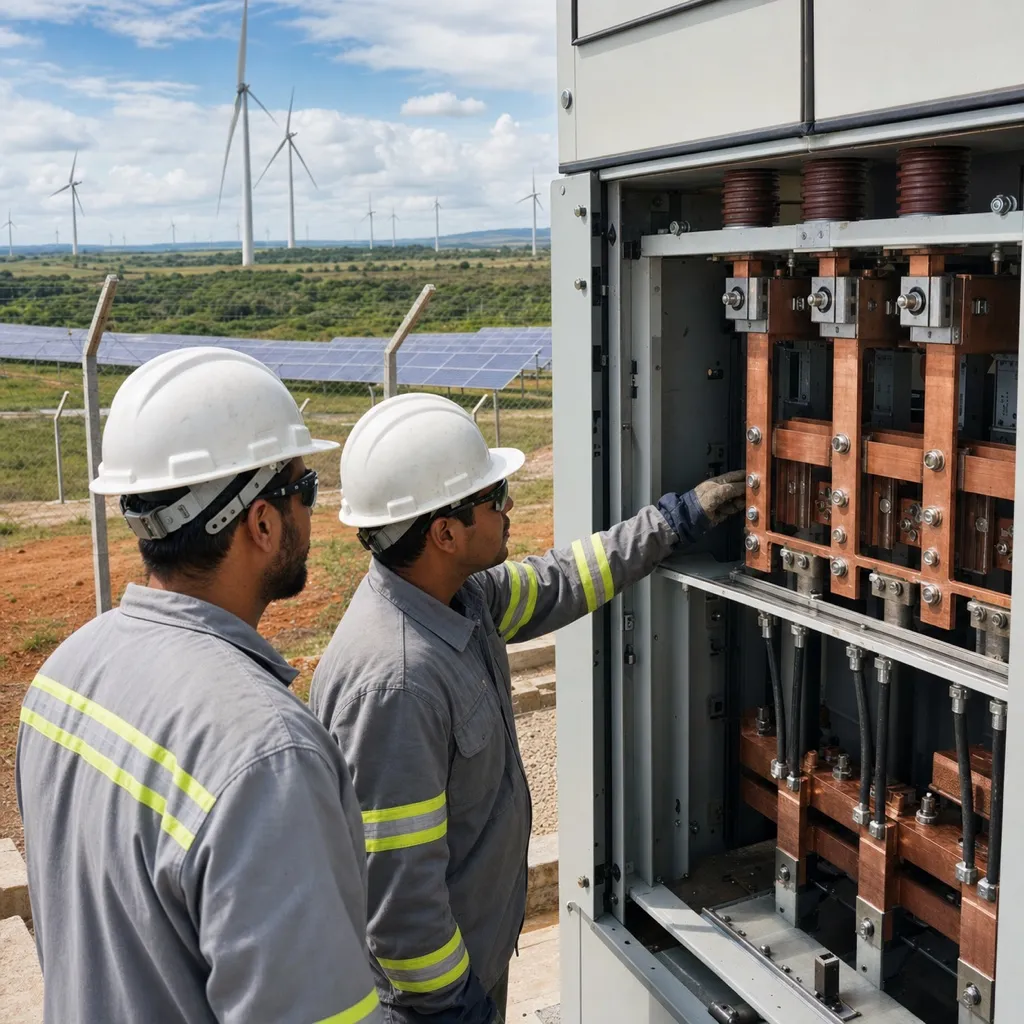
Brazil generates 92% of its electricity from renewable sources—the highest share among all G20 economies—and is executing a R$150 billion (approximately $30 billion USD) transmission and generation infrastructure program through 2030, according to the Brazilian Electricity Regulatory Agency (ANEEL). This investment adds 40,000 kilometers of new transmission lines and 200+ new substations to a grid that already spans a continent-sized country with unique 60Hz frequency and regional voltage configurations. Every one of those substations requires switchgear, every switchgear assembly requires fabricated busbars, and every busbar fabrication shop needs CNC processing equipment configured for Brazil’s specific electrical and regulatory environment. At DH CNC, we have tracked a measurable but underserved search demand from Brazil—10 monthly Google impressions for Brazil-specific busbar systems queries with zero clicks—indicating a procurement audience searching for information that no one has published. This article fills that gap, covering the market drivers, import duty structure, machine configuration requirements, and practical logistics that procurement teams in Brazil’s electrical equipment sector need to make informed sourcing decisions.
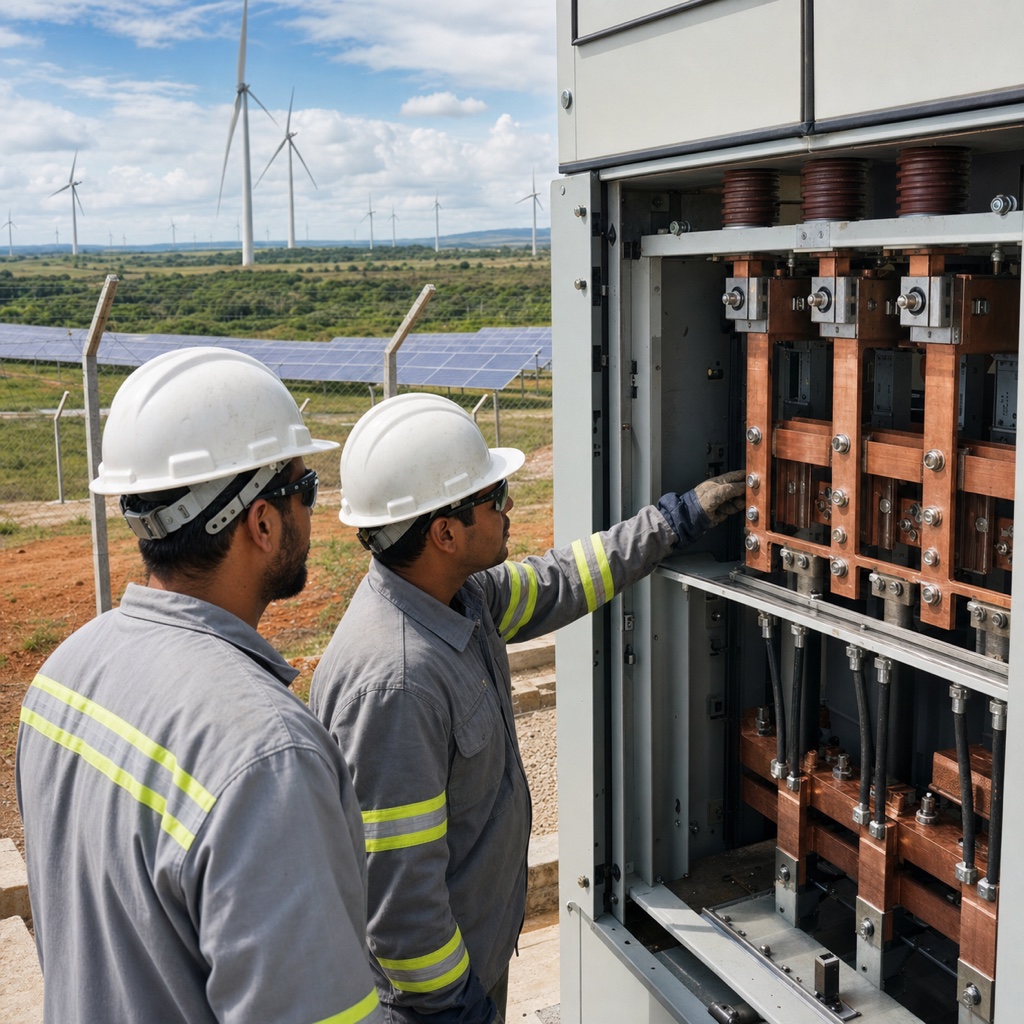
Why Is Brazil’s Electrical Equipment Market Entering a Significant Procurement Cycle in 2026?
Brazil’s position as a busbar equipment market rests on a combination that few countries can match: a grid that needs substantial expansion, an industrial base large enough to absorb switchgear production at scale, and a renewable generation mix that requires continuous transmission investment to move power from remote generation sites to load centers.
Renewable Generation Driving Transmission Demand. Brazil’s 92% renewable electricity share comes primarily from hydropower (approximately 110 GW installed capacity), wind (22 GW), and solar (35 GW+ and growing at roughly 5-8 GW per year), with biomass and small hydro filling out the balance. The geographical mismatch between generation and load is extreme: the best wind resources are in the Northeast (Rio Grande do Norte, Bahia, Piaui), the largest hydropower plants are in the North and Center-West (Itaipu, Belo Monte, Tucurui), and the major load centers are in the Southeast (Sao Paulo, Rio de Janeiro, Minas Gerais). Moving power from generation to load requires transmission—and transmission requires substations, switchgear, and busbars.
ANEEL’s 2025-2030 Transmission Expansion Plan identifies 200+ new substation projects, 40,000 km of new transmission lines, and approximately R$150 billion in total transmission and distribution investment. These are not aspirational figures. Brazil’s transmission auction model—where ANEEL tenders transmission concessions through competitive bidding, and winning bidders receive 30-year revenue contracts indexed to inflation—has successfully attracted private capital from domestic construction conglomerates, international infrastructure funds (GIC, CPP Investments, Brookfield), and Chinese state-owned enterprises (State Grid).
Industrial Electrification. Three sectors drive switchgear and busbar demand beyond utility procurement:
-
Automotive manufacturing. Brazil produced 2.4 million vehicles in 2025, according to ANFAVEA (the national automakers’ association), with Chinese automakers BYD and GWM building or expanding production facilities in Bahia and Sao Paulo states respectively. Automotive assembly plants are intensive consumers of low-voltage switchgear and busbar systems.
-
Mining electrification. Brazil is the world’s second-largest iron ore producer and a major producer of copper, nickel, bauxite, and gold. Vale, the dominant mining company, has committed to $3-4 billion in capital expenditure on electrification and emissions reduction by 2030, replacing diesel-powered mining trucks and equipment with electric alternatives that require substantial new power distribution infrastructure.
-
Data center construction. Sao Paulo is Latin America’s largest data center market, with approximately 350 MW of commissioned capacity and an additional 200+ MW in the development pipeline. Data centers are high-density electrical loads that consume extensive medium-voltage switchgear and busbar trunking systems for power distribution within the facility.
| Brazil Electrical Equipment Demand Driver | Investment Scale | Timeline | Busbar Equipment Implication |
|---|---|---|---|
| ANEEL transmission auctions | R$150B total through 2030 | 2025-2030 annual auctions | Sustained demand for switchgear busbar fabrication |
| Wind + solar capacity additions | 5-8 GW/year | Ongoing | Substation busbar demand at renewable connection points |
| Automotive manufacturing expansion | 2.4M vehicles/year (2025) | BYD/GWM facilities 2025-2027 | Factory power distribution busbar and switchgear demand |
| Mining electrification (Vale) | $3-4B CAPEX through 2030 | Active | High-current busbar systems for mining equipment power |
| Data center construction | 200+ MW pipeline | 2025-2028 | Busbar trunking systems and MV switchgear |
At DH CNC, we have seen Brazilian inquiry volume grow approximately 40% year-over-year since 2024, with particular interest in multi-function machines that can process both copper and aluminum busbars—a reflection of the mixed material requirements in Brazilian panel building, where aluminum is more common than in North American or European switchgear.
How Do Mercosur Import Duties and BNDES Local Content Rules Affect Machine Procurement?
Brazil’s import regime is among the most complex in Latin America. Understanding it is not optional—it directly determines the landed cost of a CNC busbar machine and the competitiveness of the busbars it produces.
Mercosur Common External Tariff (TEC). As a founding member of Mercosur (along with Argentina, Paraguay, and Uruguay), Brazil applies the Common External Tariff (TEC) to imports from non-member countries, including China. For CNC machine tools, the relevant NCM (Nomenclatura Comum do Mercosul) classification typically falls under Chapter 84:
| NCM Code | Product Description | Standard TEC Rate | LETEC Rate (if applicable) |
|---|---|---|---|
| 8462.21.00 | CNC bending, folding, straightening machines | 14% | Varies—verify current status |
| 8462.41.00 | CNC punching or notching machines | 14% | Varies—verify current status |
| 8462.99.90 | Other machine tools for working metal | 14% | Varies—verify current status |
Brazil maintains a List of Exceptions to the Common External Tariff (LETEC), which allows member states to deviate from TEC rates for a limited number of NCM codes—approximately 100 codes currently have modified rates. The practical implication: before placing an order, verify the current effective rate for your specific NCM code with a Brazilian customs broker. Tariff classifications can shift, and the difference between 0% (a LETEC reduction) and 14% (standard TEC) on a $100,000 machine is a $14,000 swing in landed cost.
BNDES Local Content Requirements. The Brazilian Development Bank (BNDES) finances the majority of large-scale transmission, generation, and industrial electrification projects in Brazil. BNDES financing typically requires minimum local content thresholds: the percentage of equipment and services value sourced from Brazilian suppliers must meet specified levels, typically 40-60% depending on the project category and financing program.
This local content requirement creates a procurement dynamic that is specific to Brazil: a CNC busbar machine imported from China is subject to 14% import duty, but the switchgear assemblies it produces—if fabricated in a Brazilian facility by Brazilian labor using a combination of imported and domestically sourced raw materials—may qualify the finished product for BNDES local content accreditation. The machine itself is a capital asset that enables local content compliance for the downstream product.
Documentation Checklist for Brazilian Import Clearance:
- NCM classification verification from a licensed Brazilian customs broker
- Commercial invoice with Harmonized System (HS) coding and declared customs value
- Certificate of Origin (Form A or equivalent for GSP eligibility—verify current China-Brazil GSP status)
- Packing list with individual item weights and dimensions
- RADAR registration (Brazilian importer’s customs registration)
- Import License (LI) if required for the specific NCM code (check with SISCOMEX)
- INMETRO certification documentation for electrical equipment (see below)
For procurement teams navigating these requirements, our export documentation team provides the commercial invoice and packing list structured to Brazilian customs specifications. We recommend working with a Sao Paulo or Santos-based customs broker who has specific experience with NCM Chapter 84 machinery imports—the classification decisions have multi-thousand-dollar consequences.
What 60Hz/440V Machine Configuration Do Brazilian Panel Builders Actually Need?
Brazil’s grid operates on 60Hz—the same nominal frequency as North America and Mexico—but with regional voltage variation that catches first-time equipment buyers off guard.
Regional Voltage Configuration. Brazilian industrial facilities typically operate on three-phase at either 440V or 380V, depending on the regional utility concession. The state of Sao Paulo (the industrial heartland, accounting for roughly 30% of Brazil’s GDP) predominantly uses 440V. Other states, particularly in the South and parts of the Northeast, use 380V. Some facilities in Minas Gerais and Rio de Janeiro may have either configuration.
For a CNC busbar processing machine, the configuration implications are:
| Specification | Requirement for Brazil | Why It Matters |
|---|---|---|
| Motor frequency | 60Hz—mandatory | A 50Hz motor on 60Hz runs 20% overspeed; hydraulic pump damage within hours |
| VFD input voltage | 380-440V three-phase, 60Hz | Must accommodate regional voltage without external transformer |
| Control transformer | Multi-tap primary: 380V/400V/440V | Allows single machine configuration for any Brazilian state |
| PLC/HMI language | Portuguese | NR-12 requirement for operator safety comprehension |
| Safety markings | Portuguese-language emergency stop, warning labels | NR-12 mandatory; Portuguese is the only acceptable language |
| Documentation | Portuguese operator manual, electrical schematics, maintenance schedule | NR-12 and INMETRO requirement |
INMETRO Certification. INMETRO (National Institute of Metrology, Quality and Technology) regulates electrical equipment sold in Brazil. For industrial machinery, INMETRO certification typically applies to the electrical panel and safety systems, not the mechanical structure. The certification process involves testing by an INMETRO-accredited laboratory (or an ILAC-accredited lab with mutual recognition) against the applicable Brazilian technical standards (ABNT NBR).
For busbar processing machines, the relevant standards include:
- ABNT NBR IEC 60204-1 — Safety of machinery — Electrical equipment of machines
- ABNT NBR 14153 (NR-12) — Machine safety — General requirements
NR-12 Machine Safety Compliance. NR-12 is Brazil’s machine safety regulatory standard, enforced by the Ministry of Labor and Employment. For an imported CNC busbar machine, NR-12 compliance requires:
- Fixed and interlocked guards on all moving parts (punching head, shearing blade, bending stations)
- Emergency stop buttons accessible from all operator positions (typically 3-4 locations on a DH303-8P)
- Portuguese-language safety signage and labeling
- Portuguese-language operator’s manual, including safety procedures, lockout/tagout instructions, and maintenance intervals
- Technical file (ART — Anotacao de Responsabilidade Tecnica) signed by a CREA-registered engineer for machines installed in Brazil
At DH CNC, our DH303-8P multi-function busbar processing machine ships in a dedicated LATAM configuration: 60Hz-rated main drive motors with appropriate V/Hz curves, VFDs pre-programmed for 380-440V/60Hz three-phase input, multi-tap control transformers, Portuguese-language Siemens HMI with all safety interlocks labeled in Portuguese, and NR-12 compliant guarding with documentation package. For panel builders and switchgear manufacturers who need to process larger busbar cross-sections, our LATAM-specific machine configuration guide covers the full range of frequency and voltage options across our equipment line.
We have shipped this configuration to Brazilian customers in Sao Paulo, Campinas, Curitiba, and Belo Horizonte. The feedback is consistent: a machine that arrives pre-configured for 60Hz with Portuguese documentation and NR-12 labeling is operational within 3-5 days of uncrating. A machine that requires field modification for frequency, voltage, or language compliance can sit idle for 4-8 weeks while the buyer sources motors, rewires control panels, and commissions translations.
How Does Brazil Compare to Mexico as a LATAM Busbar Equipment Market?
For equipment suppliers and procurement teams evaluating Latin American market opportunities, the Brazil-vs-Mexico comparison is the strategic framing question. The two markets share 60Hz grid frequency but differ in almost every other procurement-relevant dimension.
| Market Characteristic | Brazil | Mexico |
|---|---|---|
| Grid frequency | 60Hz | 60Hz |
| Standard industrial voltage | 440V/380V (regional variation) | 440V/480V |
| Market size (GDP) | $2.1T (2025) | $1.8T (2025) |
| Transmission investment | R$150B (~$30B) through 2030 | MXN 624.6B (~$35B) through 2030 |
| Import duty on CNC machines | 14% (TEC, NCM Ch. 84) | 0-15% (varies by FTA; MFN rate) |
| Trade agreement with China | Mercosur—no bilateral FTA | No bilateral FTA; USMCA covers North America |
| Local content rules | BNDES 40-60% for financed projects | CFE local content preferences (less formalized) |
| Certification | INMETRO, NR-12 (Portuguese) | NOM (Spanish) |
| Logistics (from Jinan) | 35-45 days to Santos | 22-28 days to Manzanillo |
| Payment infrastructure | Developed banking; BNDES financing common | Developed banking; IMMEX program for maquiladoras |
| Language | Portuguese | Spanish |
Strategic Approach by Market:
- Mexico is the faster-entry market: shorter shipping times, simpler import procedures, and nearshoring-driven demand that is creating immediate equipment orders. The IMMEX duty deferral program provides a clear trade advantage for U.S.-linked manufacturers.
- Brazil is the larger long-term opportunity: a bigger economy, more ambitious grid buildout, and less competitive supplier landscape. The import barriers are higher (14% duty, NR-12 compliance, Portuguese documentation), but the barriers create a moat—fewer international suppliers are willing to invest in the compliance overhead, which means less price competition for those who do.
Brazil is not the only 60Hz market driving busbar equipment demand. Saudi Arabia—operating on 60Hz/380V with its own SASO certification requirements and giga-project-driven procurement cycle—presents a parallel opportunity in the GCC region, analyzed in our GCC busbar systems market guide.
Brazil’s renewable generation mix also creates a different demand profile for busbar equipment. Wind and solar farms require collection substations with extensive medium-voltage switchgear; hydropower plants require generator busbars and excitation system busbars at the generation end. These are application-specific busbar geometries that benefit from CNC flexibility rather than dedicated hard tooling.
For procurement teams evaluating both markets, we recommend reviewing our Mexico energy reform and switchgear busbar demand analysis for the Mexico-specific investment case and our FOB/CIF/DAP shipping guide for CNC busbar machines from China for logistics cost comparisons between Santos, Manzanillo, and other LATAM ports.
What Logistics and Payment Considerations Apply to Brazilian Machine Imports?
The practical details of getting a CNC busbar machine from our factory in Jinan, China, to a customer’s facility in Brazil are where procurement timelines are made or broken.
Port Options and Transit Times. Brazil has three major container ports that handle industrial machinery imports:
| Port | Location | Transit from Shanghai/Qingdao | Container Availability | Notes |
|---|---|---|---|---|
| Santos | Sao Paulo state | 35-45 days | High | Largest port; 2-3 day truck to Sao Paulo industrial region |
| Paranagua | Parana state | 35-42 days | Moderate | Good access to Curitiba and Southern Brazil |
| Itajai/Navegantes | Santa Catarina state | 33-40 days | Moderate | Good access to Southern Brazil; less congestion than Santos |
Santos handles approximately 40% of Brazil’s container traffic. Its proximity to the Sao Paulo-Campinas industrial corridor makes it the default port for most machinery imports. However, Santos has recurring congestion during sugar and soybean export seasons (typically March-June and September-November). Paranagua or Itajai can be faster during Santos congestion periods, particularly for deliveries to Southern Brazil.
Customs Clearance Timeline. Brazilian customs clearance is document-intensive and can take 7-15 business days from vessel arrival to cargo release, assuming documentation is complete and correct. The most common delays: incorrect NCM classification requiring re-filing, missing INMETRO documentation for electrical components, and SISCOMEX (the electronic customs system) parameterization that selects shipments for physical inspection. Physical inspection adds 3-5 business days minimum.
Payment Terms. Brazilian import financing typically follows one of these structures:
- Letter of Credit (L/C) at sight: Most common for first-time transactions. The Brazilian bank issues an irrevocable L/C confirmed by a Chinese bank. Payment is released upon presentation of compliant shipping documents.
- Financed L/C: BNDES or a Brazilian commercial bank extends credit to the importer, with deferred payment terms (typically 180-360 days). The Chinese exporter receives payment at sight from the confirming bank; the Brazilian importer repays the financing bank over the agreed term.
- Telegraphic Transfer (T/T) with deposit: 30-50% deposit with order, balance before shipment or against copy documents. Common for repeat customers or lower-value transactions.
Incoterms Recommendation. For Brazilian machinery imports, CIF Santos (Cost, Insurance, and Freight to Port of Santos) is the standard commercial term. The supplier arranges and pays for ocean freight and marine insurance up to the Brazilian port of discharge. The buyer handles import customs clearance, import duties, domestic freight, and inland insurance. For buyers who prefer to control the freight forwarding relationship, FOB Qingdao shifts the freight and insurance responsibility to the buyer after the container is loaded on the vessel.
Our factory has shipped 60Hz LATAM-configured machines to Brazil since 2018. The export documentation package we provide—commercial invoice with HS/NCM coding, detailed packing list, certificate of origin, and INMETRO/NR-12 compliance documentation—is structured to minimize customs clearance friction. For new customers entering the Brazilian market, we can connect you with freight forwarders and customs brokers who have specific experience with NCM Chapter 84 machinery imports.
For manufacturers ready to evaluate equipment specifications against their Brazilian production requirements, our multi-function busbar processing center (DH303-8P) product page provides detailed technical specifications including 60Hz power configuration options. We also recommend reviewing our custom solutions for substation and power distribution busbar fabrication for application-specific machine recommendations. For a detailed landed-cost analysis including current Mercosur duty rates and shipping costs to your specific Brazilian destination, request a quote and our export team will prepare a CIF pricing proposal.
Frequently Asked Questions (FAQs)
How large is the Brazilian busbar and electrical equipment market?
Brazil is Latin America's largest electrical equipment market, driven by: (1) 92% renewable electricity generation—the highest share among G20 economies—with continuous investment in hydropower, wind (22 GW installed), and solar (35 GW+) capacity; (2) R$150 billion in transmission infrastructure investment through 2030, including 40,000 km of new transmission lines and 200+ new substations tendered by ANEEL; (3) industrial electrification across automotive (Brazil produced 2.4 million vehicles in 2025), mining (Vale's electrification program), and data center construction. The Brazil-specific busbar systems market query generated 10 monthly Google impressions in GSC data but zero clicks—indicating a market with genuine demand but no content serving it.
What are Brazil's import duties and local content rules for busbar processing machines?
Brazil applies Mercosur's Common External Tariff (TEC) to imported industrial machinery, typically 14% for CNC machine tools classified under NCM Chapter 84. However, Brazil maintains a List of Exceptions (LETEC) that can raise or lower rates for specific NCM codes—currently approximately 100 codes have modified rates. For BNDES-financed infrastructure projects (which cover most major transmission and generation investments), local content requirements apply: equipment and services must meet minimum thresholds for Brazilian-sourced content, typically 40-60% depending on the project category. Imported busbar processing machines used to manufacture busbars that go into BNDES-financed switchgear assemblies may qualify the finished product for higher local content accreditation. The key documentation: NCM classification verification, Mercosur Certificate of Origin for any preferential treatment, and BNDES local content accreditation plan if supplying to financed projects.
What voltage and frequency configuration does a busbar machine for Brazil require?
Brazil operates on a 60Hz grid but with regional voltage variations: most industrial facilities use 440V or 380V three-phase. Key specification requirements: (1) all motors, VFDs, and control transformers must be 60Hz-rated—a 50Hz machine will run motors 20% overspeed; (2) voltage configuration must match the customer's specific facility (440V and 380V are both common—verify before shipment); (3) INMETRO certification applies to electrical equipment sold in Brazil, with specific labeling and documentation requirements; (4) NR-12 (Brazil's machine safety regulation) requires Portuguese-language safety markings, emergency stop labeling, and operator manuals. Our DH303-8P ships in LATAM configuration with 60Hz motors, 440V/380V selectable input, Portuguese-language Siemens HMI, and INMETRO/NR-12 compliance documentation.
DH303-8P 3-in-1 CNC Busbar Processing Machine
Discover details, parameters, standard dies packages, and factory quotes.