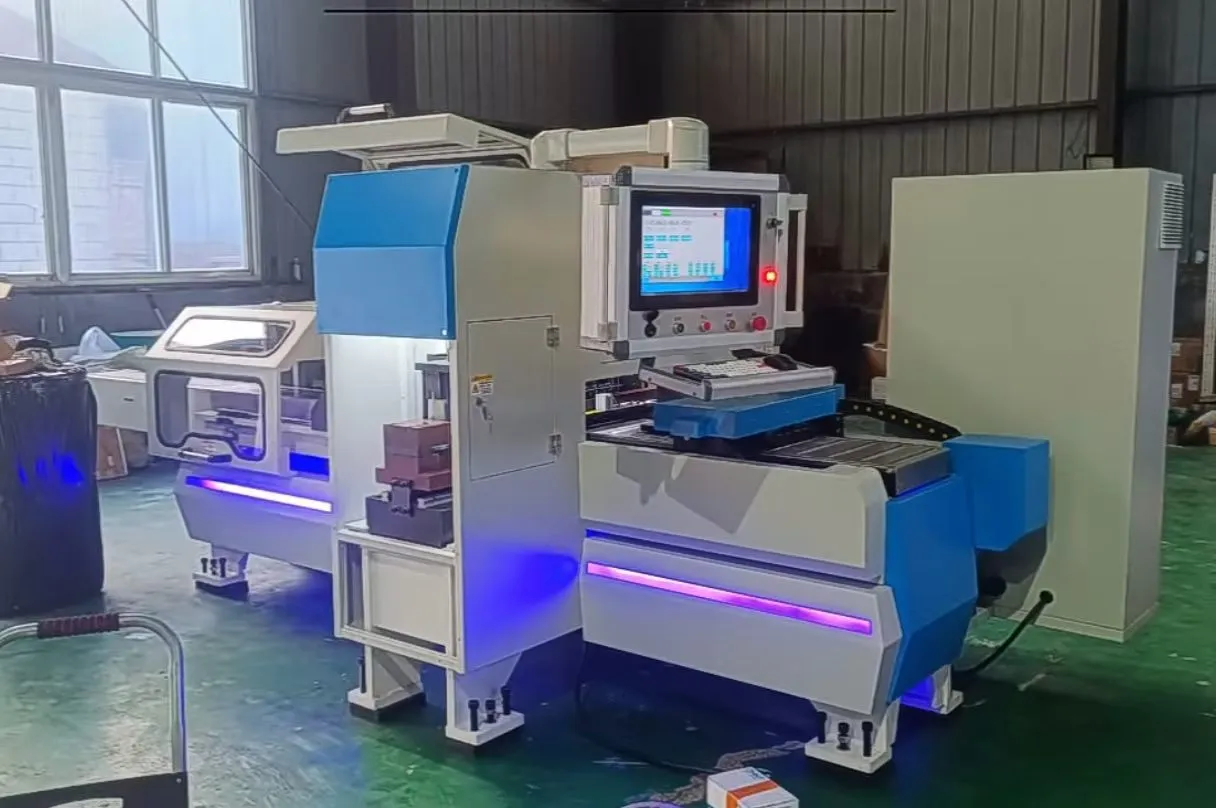
How to Qualify a CNC Busbar Machine Supplier in China: The 2026 Procurement Checklist
Sourcing Summary
Sourcing a CNC busbar processing machine from China in 2026 requires a fundamentally different procurement playbook than even two years ago. With LME copper trading in the $10,000 to $13,500 per metric ton range, the margin pressure on switchgear, EV busbar, and power distribution manufacturers has intensified dramatically — according to the London Metal Exchange (LME). Simultaneously, the U.S. Section 301 tariffs on Chinese industrial machinery now span 25% to 100% depending on HS code classification, creating a compliance minefield for North American buyers. At DH CNC, our factory in Jinan has shipped over 500 machines to 40-plus countries, and I have personally guided dozens of procurement managers through qualification audits that separate direct manufacturers from the estimated 60% of “suppliers” who are actually trading companies. This guide distills our engineering team’s collective experience into a 7-point supplier qualification framework, covering everything from live video audit protocols to financial health verification through China’s National Enterprise Credit Information Publicity System.

What Does the 2026 Chinese Busbar Machine Manufacturing Landscape Look Like?
Understanding the geography of Chinese industrial manufacturing is the first step in qualifying a supplier. The CNC busbar machine industry in China is concentrated across three primary industrial clusters, each with distinct characteristics that directly affect machine quality, lead times, and after-sales capability.
The Shandong province cluster, centered around Jinan, is the historical heartland of China’s busbar processing machine industry. Our own factory sits within this ecosystem, where generations of mechanical engineering expertise have accumulated since the 1990s. Shandong manufacturers typically operate vertically integrated facilities — meaning casting, machining, assembly, and testing happen under one roof. If you are buying a multi-function 3-in-1 unit like our DH303-8P workstation, the monoblock ductile iron casting beds, Cr12MoV tooling, and Siemens PLC control cabinets should all be traceable to in-house or tightly controlled supply chains within this cluster.
The Jiangsu province cluster, centered around Suzhou and Wuxi, skews toward higher-end servo-driven systems and often supplies components to automotive-tier manufacturers. These factories tend to have stronger electronics integration capabilities and more experience with export compliance documentation.
The Zhejiang province cluster, anchored by manufacturing hubs like Wenzhou and Yueqing, is dominated by smaller workshops producing lower-cost, mechanically simpler machines. These factories frequently operate as component assemblers rather than true manufacturers, sourcing castings, hydraulics, and electrical cabinets from third-party vendors and performing final assembly only.
| Manufacturing Cluster | Core Strengths | Typical Specialization | Red Flags to Watch For |
|---|---|---|---|
| Shandong (Jinan) | Vertical integration, casting expertise, hydraulic R&D | Multi-function 3-in-1 machines, heavy-tonnage bending centers | Some smaller Jinan workshops operate out of shared industrial parks with no in-house casting capability. |
| Jiangsu (Suzhou/Wuxi) | Servo-drive electronics, automotive-grade QC, export documentation | High-speed servo punching centers, EV busbar-specific lines | Some Jiangsu firms are design houses that outsource all manufacturing; verify physical assembly floor. |
| Zhejiang (Wenzhou/Yueqing) | Cost-competitive simple machines, rapid order fulfillment | Entry-level punching-shearing units, manual bending tools | High proportion of pure trading companies; always request factory registration certificate and on-site video. |
How Can You Distinguish a Direct Manufacturer from a Trading Company?
This is the single question I hear most frequently from first-time buyers, and it is the one where mistakes carry the highest cost. Trading companies operate by purchasing machines from actual factories, applying their own branding, and marking up the price by 15% to 40%. Worse, they provide zero post-installation technical support because they have no engineering team. Here are seven verification methods that our procurement engineering team recommends deploying before signing any contract.
Method 1: Live Video Factory Walkthrough
A trading company cannot show you a real factory floor because they do not have one. Request a live, unscripted video call — not a pre-recorded tour — and ask the sales representative to walk from the office area directly onto the production floor without cutting the feed. Genuine manufacturers have no transition delay between admin offices and assembly bays. During the call, ask them to show the following live:
- The raw casting yard: You should see grey iron monoblock machine beds in various stages of machining, still attached to casting gates and risers.
- Heat treatment furnace area: Ask them to open the furnace door on camera. If they cannot show you an operational annealing or stress-relief furnace, the castings are being purchased externally.
- Hydraulic test rigs: A legitimate manufacturer tests every assembled machine’s hydraulic circuit at 31.5 MPa for a minimum of 72 continuous hours before crating. Ask to see a machine currently undergoing this test, with the pressure gauge visible and the hour counter running.

Method 2: Business License Cross-Verification
Every Chinese manufacturer has a unified social credit code registered with the State Administration for Market Regulation (SAMR). Request the supplier’s business license (ying ye zhi zhao) and verify the following fields:
- Registered capital (zhu ce zi ben): For a credible CNC busbar machine manufacturer, this should be at least RMB 5 million (approximately $690,000). Trading companies frequently have registered capital below RMB 1 million.
- Business scope (jing ying fan wei): The scope must explicitly list “manufacturing of metal processing machinery” as the primary business activity. If the scope lists “trading” or “import-export” as the primary activity, you are dealing with a trading company.
- Establishment date: Companies established within the last 2 to 3 years with no prior industrial track record warrant heightened scrutiny.
Method 3: Export License and Customs Records
Request the supplier’s Customs Registration Certificate (hai guan bao guan dan wei zhu ce deng ji zheng shu) and ask for a redacted copy of their recent bill of lading or customs declaration form for an export to your region. A legitimate manufacturer that has shipped to 40-plus countries — as we have at DH CNC — can produce this documentation within minutes. A trading company will stall, claim confidentiality, or provide documentation that does not match the factory name on the business license.
Method 4: On-the-Ground Factory Visit Logistics
If you or a local agent can visit in person, the logistics of the visit itself are revealing. A genuine manufacturer in Jinan’s industrial zone will have a reception protocol: safety helmet distribution, factory-floor noise levels consistent with active machining, and staff who can answer technical questions about casting alloy composition or hydraulic circuit design without deferring to a phone call. A trading company will attempt to redirect you to a third-party factory, often with a carefully scripted “factory visit” that takes place at a facility the trading company does not own.
Method 5: Engineering Depth Test
During technical discussions, pose a specific engineering question that only a manufacturer’s in-house engineering team could answer. For example: “What is your specified punch-to-die clearance for 10mm-thick T2 half-hard copper, and how does that clearance change when processing 6101-T6 aluminum at the same thickness?” A trading company’s salesperson will deflect or provide a generic answer. A manufacturer’s engineer will immediately respond with specific clearance values — for us, that is 5% to 8% of material thickness for T2 copper and 8% to 10% for 6101-T6 aluminum — and explain the rationale based on shear strength differentials.
Method 6: After-Sales Engineering Team Verification
Ask to speak directly with a service engineer — not a salesperson — and pose a real-world troubleshooting scenario. For example: “If a customer in Mexico running on 440V/60Hz reports hydraulic pump cavitation six months after installation, what is your diagnostic protocol?” A manufacturer will describe a step-by-step remote diagnostic procedure, potentially including cloud-based PLC log analysis. A trading company will promise to “check with the factory” — which is exactly what you are trying to avoid.
Method 7: Third-Party Inspection Report History
Request copies of previous third-party inspection reports from recognized agencies such as SGS, Bureau Veritas, or TUV Rheinland. A manufacturer that has successfully passed third-party pre-shipment inspections (PSI) for international clients will maintain these records. The inspection report should reference the same factory address on the business license.
| Verification Method | Factory Signal (Positive) | Trading Company Signal (Red Flag) |
|---|---|---|
| Live video walkthrough | Unscripted, no-delay transition from office to factory floor; visible casting inventory | Pre-recorded video; “factory is closed today”; cuts in footage between locations |
| Business license check | Registered capital > RMB 5M; business scope includes “metal processing machinery manufacturing” | Registered capital < RMB 1M; scope lists “trading” or “import-export” as primary |
| Customs documentation | Provides redacted bill of lading immediately; exporter matches business license | Stalls, claims confidentiality; exporter name differs from factory name |
| Engineering depth test | Immediate, specific answer with material science rationale | Generic response; defers to “technical department will check” |
| After-sales engineer access | Direct call with service engineer who describes diagnostic protocol | No engineer available; “sales team handles all inquiries” |
| Third-party inspection history | Multiple past SGS/Bureau Veritas reports referencing same factory address | No inspection history; or reports reference a different facility |
How Do Section 301 Tariffs and Geopolitical Risks Impact Your 2026 Procurement Decision?
The geopolitical landscape for U.S.-China industrial trade has shifted materially since 2024. The Section 301 tariffs imposed by the Office of the United States Trade Representative (USTR) on Chinese-origin industrial machinery currently range from 25% to 100% of the CIF (Cost, Insurance, and Freight) value, depending on the specific HS code under which the machine is classified. CNC busbar processing machines typically fall under HS codes 8462 (machine tools for working metal by bending, folding, straightening) or 8463 (other machine tools for working metal), but the exact classification — and therefore the applicable tariff rate — must be verified with a licensed customs broker before issuing a purchase order.
From our experience shipping to North American clients over the past three years, a $80,000 multi-function busbar machine with $5,000 in sea freight and insurance could attract an additional $21,250 to $85,000 in Section 301 duties alone, depending on the HS code determination. That is not a rounding error — it fundamentally changes the ROI calculation.
Beyond tariffs, procurement managers must now assess broader geopolitical supply chain risk. The U.S. Department of Commerce Bureau of Industry and Security (BIS) has expanded its Entity List restrictions over the past 18 months, and while CNC busbar machinery is not currently subject to export controls, the regulatory environment can shift rapidly. Our recommendation to clients is to maintain at least one qualified alternative supplier outside of China — in markets such as Turkey, India, or Southeast Asia — as a supply chain diversification hedge, even if the primary supplier remains Chinese.
For European buyers, the situation is more stable. The EU does not impose Section 301-equivalent tariffs on Chinese industrial machinery, and CE certification for CNC busbar machines can typically be handled by the manufacturer through a notified body. Our DHCNC-BP-60 and DH303-8P series are CE-certified, with compliance documentation available during the audit process.
How Can You Assess the Financial Health of a Chinese CNC Busbar Machine Manufacturer?
A technically competent manufacturer that goes bankrupt six months after receiving your deposit is arguably worse than a trading company. Financial due diligence on Chinese suppliers has historically been opaque, but several legally mandated disclosure systems now provide accessible verification pathways.
National Enterprise Credit Information Publicity System (Guo Jia Qi Ye Xin Yong Xin Xi Gong Shi Xi Tong)
China’s SAMR operates a publicly accessible database at gsxt.gov.cn that contains every registered company’s annual reports, shareholder structure, registered capital, administrative penalties, and — critically — whether the company is listed as having “abnormal operations” (jing ying yi chang). The website is available in Chinese; use a browser translator or work with a Mandarin-speaking procurement agent. Key data points to extract:
- Annual report filing status: A company that has not filed annual reports for one or more years is either defunct or operating outside regulatory compliance. This is an immediate red flag.
- Equity pledge records (gu quan chu zhi): If the company’s equity has been pledged as collateral for loans, this indicates financial stress. Multiple equity pledges over a short period suggest cash-flow problems.
- Administrative penalty records: Frequent environmental or tax penalties indicate poor operational management that may eventually affect production continuity.
Supplier Financial Stability Indicators
| Financial Health Indicator | How to Verify | What Constitutes a Red Flag |
|---|---|---|
| Registered capital | Business license or gsxt.gov.cn | Below RMB 5 million ($690K); or fully paid-in capital significantly lower than registered capital |
| Annual report filing | gsxt.gov.cn annual report section | Missing one or more years of annual reports; inconsistent revenue figures year-over-year |
| Equity pledges | gsxt.gov.cn equity pledge records | Multiple pledges within 12 months; pledgee is a shadow banking entity rather than a regulated bank |
| Legal judgments | China Judgments Online (wenshu.court.gov.cn) | Multiple labor dispute judgments (indicates payroll instability); unpaid supplier judgments (indicates cash-flow crisis) |
| Export consistency | China Customs statistics or supplier-provided bills of lading | Sharp drop in export volume year-over-year; no export activity in the past 6 months |
| Factory ownership | Land use rights certificate or long-term lease agreement | Month-to-month lease on factory premises; factory address changes frequently |
What Should Your Remote Video Audit Protocol Cover in 2026?
The post-COVID era permanently changed how industrial procurement operates. In-person factory visits are ideal, but a properly structured remote video audit can achieve 80% to 90% of the verification value at a fraction of the time and cost. At DH CNC, we have conducted over 200 remote audits for international clients since 2020, and I can tell you exactly what separates a meaningful audit from a performative factory tour.
Phase 1: Pre-Audit Documentation Review (Complete Before the Call)
Request and review the following documents at least five business days before the scheduled video audit:
- Business license (ying ye zhi zhao) with unified social credit code
- ISO 9001:2015 and/or GB/T 19001-2016 certificates, with certificate numbers
- Export license (jin chu kou jing ying quan) and customs registration certificate
- CE certificate (for EU-bound machines) or UL certification (for North America)
- Bill of materials for the specific machine model under quotation, specifying brand and origin of: hydraulic pumps, proportional valves, servo motors, PLC controller, linear guide rails, ball screws, electrical contactors, and touchscreen HMI
- Quality control plan covering incoming material inspection, in-process inspection checkpoints, and final acceptance test protocol
- Three most recent bills of lading to your region (company names may be redacted; port of destination and HS code must be visible)
Phase 2: Live Video Audit Walkthrough (90 to 120 Minutes)
Structure the call into five mandatory segments. Do not allow the supplier to dictate the tour sequence — you control the agenda.
Segment 1 — Raw Material and Casting Inspection (15 minutes): Walk to the raw casting yard. Count the number of monoblock machine beds in inventory. A manufacturer producing 15 to 20 machines per month should have at least 30 to 40 casting beds visible across various stages of stress-relief annealing and machining. Ask to see the spectrometer used for incoming alloy composition verification. If they do not have an in-house spectrometer, they cannot verify the ductile iron grade of their own castings.
Segment 2 — Machining Floor (20 minutes): Focus on the gantry CNC milling machine used to machine the monoblock bed surfaces. This is typically the largest machine tool on the factory floor. Ask for the manufacturer and model number of the gantry mill. A genuine manufacturer using a Taiwanese or German gantry mill (such as Hartford or Waldrich Coburg) to machine their own castings has made a multi-million-RMB capital investment that a trading company cannot fake.
Segment 3 — Hydraulic Assembly and Testing (25 minutes): Observe a machine undergoing its 72-hour continuous hydraulic stress test. The pressure gauge should read 31.5 MPa. The hour counter should be running. Ask the test engineer what specific failure modes they are monitoring for during the test — a qualified engineer will describe checks for internal seal leakage, proportional valve hysteresis, and oil temperature stabilization. Walk to the hydraulic component storage area and verify that pump brands match the bill of materials.
Segment 4 — Electrical Cabinet Assembly (20 minutes): Open an electrical cabinet currently being wired. Verify that the PLC controller, contactors, relays, and terminal blocks match the specified brands in the bill of materials. A common cost-cutting tactic is to substitute branded components with domestic equivalents after the sample machine has been inspected. Verify wire-gauge specifications against the machine’s total power rating.
Segment 5 — Packaging and Logistics (15 minutes): Walk to the finished goods area. Observe how machines are crated for export. At our factory, every machine is vacuum-sealed with a desiccant moisture barrier, then enclosed in a fumigated plywood crate with steel-reinforced corner brackets. The crate should be labeled with the destination port, consignee name, and machine serial number. Shrink-wrap alone is not adequate for ocean freight.

Phase 3: Post-Audit Verification
- Cross-reference the GPS coordinates of the factory location (obtained during the video call) with the address on the business license.
- Verify the ISO 9001 certificate number on the CNCA website at cx.cnca.cn.
- Cross-reference the PLC and hydraulic component serial numbers against the manufacturer’s own authenticity verification systems if available.
- Request a sample of the machine’s calibration certificate, which should reference NIST-traceable or CNAS-accredited measurement standards.
How Should You Structure Payment Terms and Trade Assurance for Maximum Protection?
Payment terms are your single most powerful risk-mitigation tool when importing industrial machinery from China. The standard T/T (telegraphic transfer) structure that Chinese manufacturers propose — 30% deposit, 70% before shipment — places nearly all the risk on the buyer. Here are the negotiation benchmarks that experienced procurement managers use.
Standard Payment Term Structures
| Payment Structure | Risk Distribution | When to Use |
|---|---|---|
| 30% T/T deposit + 70% before shipment | All risk on buyer after balance payment | Only for long-established relationships with manufacturers you have audited and commissioned previously. Not recommended for first transactions. |
| 30% T/T deposit + 60% against video inspection + 10% retention | Moderate risk; buyer retains leverage | Standard for first-time transactions under $100,000. The 10% retention is payable 30 days after successful commissioning at your facility. |
| Irrevocable L/C at sight | Balanced risk; bank-guaranteed payment | Mandatory for transactions exceeding $100,000. The L/C should require presentation of: commercial invoice, packing list, bill of lading, certificate of origin, third-party inspection report (SGS/BV), and factory test report. |
| 30% T/T deposit + 70% L/C at sight | Lower risk; combines deposit leverage with bank guarantee | Recommended for transactions exceeding $200,000 with new suppliers. |
Trade Assurance and Escrow
Alibaba Trade Assurance provides a limited safety net for transactions conducted through the platform, capping at $50,000 per order. However, its dispute resolution process favors the buyer only when documentation is meticulously maintained. For transactions outside Alibaba’s ecosystem, we recommend engaging a third-party escrow service or structuring the transaction through a confirmed Letter of Credit from a major international bank such as HSBC or Standard Chartered, both of which have extensive China trade finance operations.
One practice we actively encourage at DH CNC is the retention clause: 5% to 10% of the total contract value held back for 30 to 60 days after the machine arrives at your facility. This retention is released only after you confirm that the machine has been successfully commissioned and is operating within its specified tolerances. A manufacturer that refuses a retention clause — particularly on a first transaction — is a manufacturer that lacks confidence in its own product quality.
What Are the Five Red Flags That Signal a Trading Company Posing as a Factory?
Over 15 years of exporting CNC busbar machines from Jinan, I have seen every variation of the trading-company-disguised-as-factory scheme. These five red flags are the most reliable indicators that you are not dealing with a direct manufacturer.
Red Flag 1: The “Factory Name” Does Not Match the Export License. When you receive the proforma invoice, check the company name against the business license and customs registration. Trading companies often operate under a brand name that sounds like a manufacturer (e.g., “Jinan Heavy-Duty CNC Machinery Co.”) while the actual exporting entity is a separate trading company with a completely different legal name. If the proforma invoice issuer, the bank account holder, and the factory name on the business license are three different entities, terminate the negotiation.
Red Flag 2: They Cannot Show You the Raw Casting Yard. A CNC busbar machine’s structural integrity begins with its monoblock ductile iron casting bed. If the supplier cannot show you grey iron castings in their raw state — still attached to risers, with casting sand residue visible — they are not manufacturing machines. They are buying finished machines from someone else. No casting yard, no manufacturer. It is that simple.
Red Flag 3: The Sales Representative Cannot Answer Basic Metallurgy Questions. Ask the salesperson: “What grade of ductile iron do you use for your monoblock beds, and what is the specified tensile strength?” The correct answer from a manufacturer is “QT500-7, with a minimum tensile strength of 500 MPa and 7% elongation.” A trading company representative will not know what QT500-7 means. This is not an unfair trick question — it is fundamental to the machine’s engineering integrity. Our own monoblock beds are cast from QT500-7 ductile iron and stress-relieved through a 48-hour annealing cycle before precision machining.
Red Flag 4: They Offer an Unusually Wide and Unrelated Product Range. A trading company’s website will list CNC busbar machines alongside woodworking CNC routers, laser cutting machines, and hydraulic press brakes. A genuine busbar machine manufacturer specializes. At DH CNC, our entire product line is focused on copper and aluminum busbar processing: bending, punching, shearing, and multi-function combination workstations. If their product catalog looks like an Alibaba category page, they are a general trading operation.
Red Flag 5: They Refuse or Excessively Delay Third-Party Inspection. When you propose engaging SGS, Bureau Veritas, or TUV Rheinland for a pre-shipment inspection at the factory location, a genuine manufacturer will agree and provide the factory GPS coordinates and a point of contact within 24 hours. A trading company will delay, propose an alternative inspection location, or claim that third-party inspection is “unnecessary given our quality systems.” Walk away from any supplier that resists independent inspection.
How Should You Build a Long-Term Supplier Partnership Beyond the First Transaction?
Qualifying a supplier is not a one-time exercise. At DH CNC, our most successful client relationships — some spanning over a decade and 20-plus machine purchases — are built on continuous verification. Here is what we recommend for ongoing supplier management:
- Annual re-audit: Conduct a streamlined version of the initial audit annually, either remotely or in person. Focus on any changes in factory ownership, management team, or component sourcing.
- Lot-level quality documentation: Require that every machine shipped includes its individual factory acceptance test (FAT) report, with actual measured values for bending angle repeatability, punching position accuracy, and hydraulic pressure stability — not just a pass/fail checklist.
- Serial-number traceability: Ensure that every major component (casting bed, hydraulic pump, servo motor, PLC) is logged against the machine’s serial number. This enables rapid spare-part identification if a component fails five years later.
- Direct engineer-to-engineer communication: Establish a direct channel between your maintenance team and the manufacturer’s service engineers, bypassing the sales layer for technical issues. We provide every client with a WeChat/WhatsApp group containing our lead mechanical engineer, electrical engineer, and after-sales coordinator.
For switchgear manufacturers looking to qualify a supplier for their specific application — whether it is IEC 61439-compliant switchgear panel busbar systems or high-voltage EV busbar production lines — our engineering team provides a free technical feasibility assessment. You send us your busbar drawings and production volume targets, and we return a machine configuration proposal with cycle-time estimates.
If you are ready to begin the supplier qualification process, I encourage you to request a consultation with our engineering team. We will walk you through a live video audit of our Jinan factory, provide our complete quality documentation package, and connect you directly with our lead mechanical engineer — no sales filters, no scripted presentations. Because the best way to qualify a supplier is to see the factory with your own eyes, even if it is through a camera lens.
References & Data Sources
- London Metal Exchange (LME): LME Copper Official Price and Inventory Data. Available at: https://www.lme.com/en/Metals/Non-ferrous/LME-Copper
- Office of the United States Trade Representative (USTR): Section 301 Investigation: China’s Acts, Policies, and Practices Related to Technology Transfer, Intellectual Property, and Innovation. Available at: https://ustr.gov/issue-areas/enforcement/section-301-investigations
- Certification and Accreditation Administration of China (CNCA): Online Certification Verification Platform. Available at: https://cx.cnca.cn/
- State Administration for Market Regulation (SAMR): National Enterprise Credit Information Publicity System. Available at: https://www.gsxt.gov.cn/
- U.S. Department of Commerce, Bureau of Industry and Security: Entity List and Export Administration Regulations. Available at: https://www.bis.doc.gov/
- International Electrotechnical Commission (IEC): IEC 60204-1: Safety of Machinery — Electrical Equipment of Machines.
- Fortune Business Insights: Switchgear Market Size, Share & Industry Analysis, 2024-2032. Market projected to grow from $115.6 billion to $236.8 billion at a CAGR of 9.2%.
Frequently Asked Questions (FAQs)
What is the most reliable way to verify a Chinese busbar machine manufacturer is a real factory and not a trading company?
Request a live video walkthrough of the factory floor showing the raw casting yard, heat treatment furnaces, and assembly bays. A genuine manufacturer will have monoblock casting inventory visible, in-house CNC gantry milling beds for frame machining, and active hydraulic test rigs. Cross-reference the physical address against Chinese business registration databases and verify the company's GB/T 19001-2016 certificate number on the CNCA (Certification and Accreditation Administration of China) website in real time.
How do Section 301 tariffs and geopolitical risks affect CNC busbar machine procurement from China in 2026?
Section 301 tariffs on Chinese industrial machinery currently range from 25% to 100%, depending on the HS code classification. For U.S.-based buyers, the tariff is applied to the CIF value (cost + insurance + freight), meaning a $80,000 machine could incur an additional $20,000 to $80,000 in duties. Buyers should verify the exact HS code tariff rate before issuing a purchase order and consider supply chain diversification through Southeast Asian assembly subsidiaries where applicable.
What payment terms should procurement managers negotiate with Chinese CNC busbar machine suppliers?
Standard terms for first-time transactions are 30% T/T deposit with 70% balance paid before shipment against a video inspection. For established relationships, negotiate 30% deposit, 60% against a pre-shipment inspection report, and 10% retention payable 30 days after commissioning. Always use an irrevocable Letter of Credit (L/C) for transactions exceeding $100,000, confirmed by a major international bank, to mitigate both delivery and quality risks.
DH303-8P 3-in-1 CNC Busbar Processing Machine
Discover details, parameters, standard dies packages, and factory quotes.