
How Is Canada's Grid Modernization and USMCA Trade Integration Driving Busbar Equipment Demand in 2026?
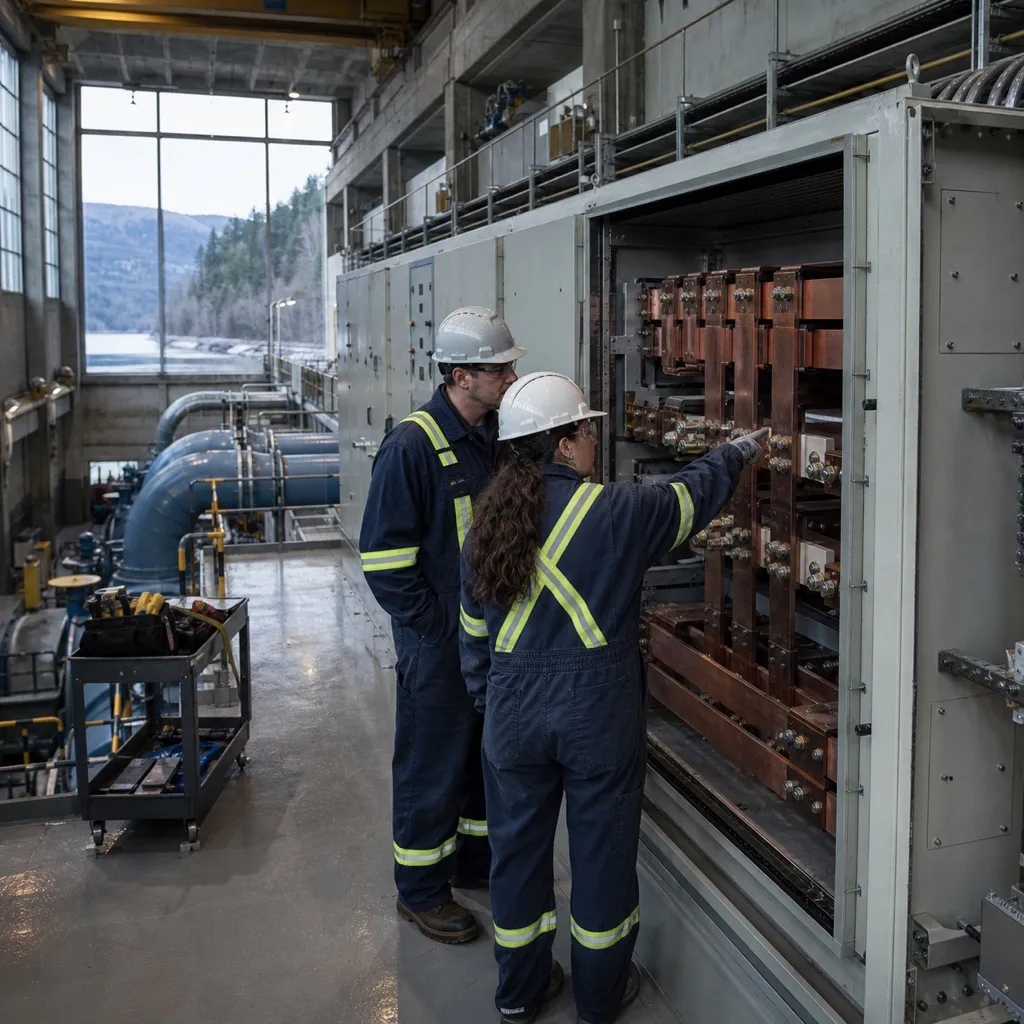
Canada’s electrical equipment market is not simply a smaller northern extension of the U.S. market. It operates on a 600V/347V three-phase 60Hz industrial system—a voltage class found nowhere else in North America—and is governed by CSA (Canadian Standards Association) certification requirements that are mandatory for all electrical equipment sold in Canada, with no reciprocity for UL or IEC certification alone. The market is anchored by over C$100 billion in committed grid modernization investment through 2035, spanning Hydro-Quebec’s C$185 billion 2035 Action Plan, Ontario’s C$15 billion nuclear refurbishment program at Darlington and Bruce, and British Columbia’s Site C dam completion adding 1,100 MW of new generation capacity. Our internal data from Google Search Console shows 56 monthly impressions from Canada for busbar systems-related queries, including 24 impressions specifically for “Canada busbar systems market”—and zero dedicated content addressing that search intent. This article is the procurement intelligence that the search data says Canadian panel builders and switchgear manufacturers are looking for but not finding: the market drivers, certification requirements, machine configuration specifications, and trade advantages that define busbar equipment procurement for the Canadian market.
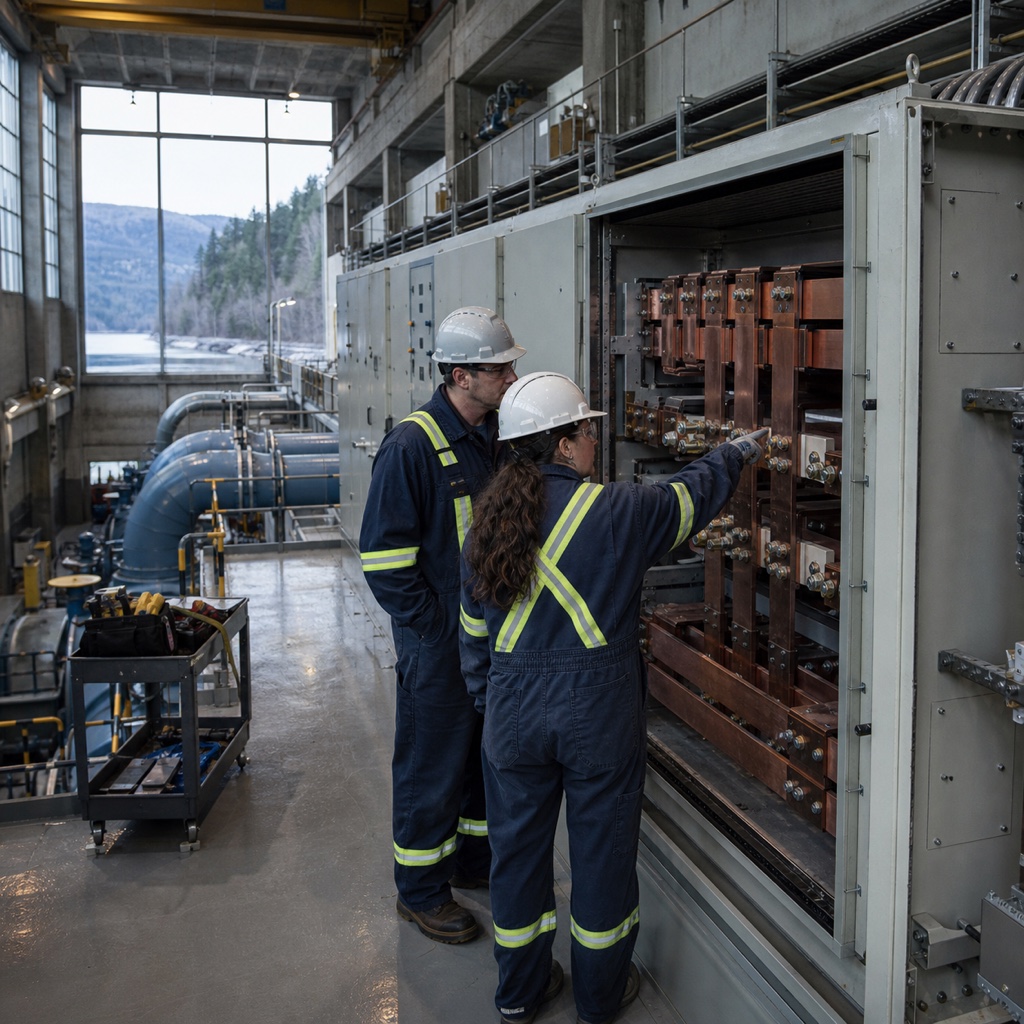
What Is Driving Canada’s Electrical Equipment Procurement Cycle in 2026?
Canada’s electrical equipment demand rests on four structural drivers that procurement teams can independently verify through public utility planning documents and government policy filings. Unlike some emerging markets where infrastructure projections are aspirational, Canada’s investment pipeline is backed by regulated utility capital expenditure plans with approved rate recovery—meaning the spending is committed, not contingent.
Provincial Utility Investment Programs. Canada’s electricity sector is provincially regulated, with each province’s utility operating under a distinct investment mandate. The three largest programs currently active:
| Utility/Program | Investment Commitment | Timeline | Key Deliverables |
|---|---|---|---|
| Hydro-Quebec 2035 Action Plan | C$185B | 2025-2035 | 8,000-9,000 MW new wind; 5,000+ MW new hydro; 4,500 km transmission |
| Ontario Power Generation (OPG) | C$15B+ | 2024-2033 | Darlington SMR (300 MW); Bruce refurbishment; Pickering life extension |
| BC Hydro — Site C | C$16B | Completion 2025 | 1,100 MW; 5,100 GWh/year; new 500kV transmission corridor |
Hydro-Quebec’s plan alone includes approximately 4,500 km of new transmission lines to connect remote wind and hydro generation to load centers in the Montreal-Quebec City corridor. Each new transmission segment terminates at a substation, and each substation requires switchgear assemblies with fabricated copper and aluminum busbars.
ZEV Mandate Infrastructure Implications. Canada’s Zero Emission Vehicle (ZEV) mandate requires 100% of new light-duty vehicle sales to be zero-emission by 2035, with interim targets of 20% by 2026 and 60% by 2030. This mandate drives two parallel electrical equipment demand streams: the charging infrastructure itself (DC fast chargers along the Trans-Canada Highway and in urban centers) and the grid capacity upgrades needed to serve that charging load. A single 350kW DC fast charging station with four dispensers represents a 1.4 MW load—equivalent to a small industrial facility—and requires its own service transformer, switchgear, and busbar assemblies.
Data Center Construction on Low-Cost Hydro Power. Quebec’s industrial electricity rate of approximately 5 cents/kWh—among the lowest in North America—is attracting hyperscale data center investment from U.S. cloud providers. Alberta is also emerging as a data center market, driven by abundant natural gas generation and a deregulated electricity market that allows direct power purchase agreements. Data centers are busbar-intensive facilities: a 100 MW campus consumes roughly 2,000-3,000 linear meters of busbar trunking systems for power distribution from medium-voltage switchgear to server rack PDUs.
Mining Electrification. Canada’s mining sector—the world’s fifth-largest by production value—is executing a structural shift from diesel-powered equipment to electric alternatives. This transition requires mine-site substations, underground power distribution, and high-current busbar systems for electric haul trucks, loaders, and drilling equipment that draw 500-1,000A continuous at 600V or 4,160V. The Mining Association of Canada’s Towards Sustainable Mining (TSM) protocol now includes electrification metrics, creating an industry-wide incentive beyond individual company commitments.
At DH CNC, our Canadian inquiry volume has increased by approximately 35% year-over-year since 2024, with particular interest from panel builders serving the utility and mining sectors. The common thread in these inquiries: the need for CSA-compliant documentation and 600V-rated electrical systems configured at the factory, not retrofitted in the field.
How Do CSA Standards Differ from UL and IEC—and What Does This Mean for Busbar Machine Procurement?
The most common mistake international equipment suppliers make when entering the Canadian market is assuming that UL certification or IEC compliance is sufficient. It is not. Canada mandates CSA certification for virtually all electrical equipment sold, installed, or operated in the country, and the standards are substantively different from their UL and IEC counterparts.
CSA C22.2 Standards for Busbar and Switchgear Equipment. The Canadian Electrical Code (CEC), codified as CSA C22.1, references a suite of CSA C22.2 product standards that govern specific equipment categories. For busbar systems and switchgear, the relevant standards are:
| CSA Standard | Equipment Category | Nearest UL Equivalent | Key Difference |
|---|---|---|---|
| CSA C22.2 No. 31 | Switchgear assemblies | UL 1558 | Different temperature rise measurement methodology; 600V rating class |
| CSA C22.2 No. 244 | Busway/busbar trunking systems | UL 857 | Different short-circuit test requirements; Canadian specific busbar ampacity tables |
| CSA C22.2 No. 29 | Panelboards and enclosed panelboards | UL 67 | 600Y/347V specific configurations; different SCCR marking requirements |
| CSA C22.2 No. 301 | Industrial electrical machinery | NFPA 79 / UL 508A | Canadian-specific control circuit voltage limits and wiring practices |
The 600Y/347V three-phase system that is standard across Canadian industrial facilities has no direct U.S. equivalent. The phase-to-phase voltage (600V) is 25% higher than the U.S. 480V standard, and the phase-to-neutral voltage (347V) is used directly for lighting circuits in commercial and industrial buildings—a configuration that has specific implications for busbar insulation coordination, creepage distances, and short-circuit current ratings.
Certification Requirements for Imported Machinery. For a CNC busbar processing machine imported into Canada, the electrical panel and safety systems must be certified by a Standards Council of Canada (SCC)-accredited certification body. The primary certification bodies operating in Canada are:
- CSA Group — the largest and most recognized
- QPS Evaluation Services — SCC-accredited; often faster turnaround
- Intertek (ETL) — widely recognized in both Canada and the US
- UL Canada — part of UL Solutions; offers dual UL/CSA marks
The certification process for an imported machine involves evaluation against CSA C22.2 No. 301 (industrial electrical machinery) and CSA C22.2 No. 0 (general requirements). This evaluation covers the electrical panel’s wiring practices, overcurrent protection, emergency stop circuits, control voltage isolation, and enclosure ratings. The process can be conducted at the manufacturer’s facility (pre-shipment inspection) or at the Canadian receiving facility (post-arrival field evaluation). Pre-shipment inspection is strongly recommended—a machine that arrives in Canada without CSA certification cannot be legally connected to power until a field evaluation is completed, which typically adds 2-4 weeks and C$3,000-$8,000 in inspection fees.
At DH CNC, we factory-configure Canadian-spec machines with CSA-compliant electrical panels and arrange pre-shipment inspection by an SCC-accredited certification body. The machine arrives in Canada with the certification mark affixed, ready for connection to the customer’s 600V supply.
For panel builders and switchgear manufacturers who need to understand the broader compliance landscape, our guide on IEC 61439-1 compliance for busbar systems provides context on how the IEC framework relates to the CSA C22.2 standards that govern the Canadian market.
Why Does Canada’s 600V/347V System Require Different Machine Configuration Than the US 480V Standard?
I have seen U.S.-sourced busbar machines show up at Canadian facilities with 480V motor nameplates and watched the receiving engineer shake their head before they even uncrate the machine. The voltage mismatch is not a minor inconvenience—it is a showstopper that delays commissioning by weeks and adds thousands of dollars in unplanned costs.
Control Transformer Voltage Requirements. The control transformer is the single component most likely to be wrong on a machine shipped to Canada from a supplier whose default configuration is U.S. 480V. A CNC busbar machine’s control system—PLC, HMI, sensors, contactor coils, solenoid valves—typically operates at 24V DC (control logic) and 110V or 220V AC (contactors, solenoids). The control transformer steps down the incoming line voltage to these control voltages.
A machine configured for the U.S. market has a control transformer with a 480V primary winding. Connected to a Canadian 600V supply, this transformer receives 25% overvoltage. The secondary side delivers approximately 137V instead of 110V, or 275V instead of 220V—enough to damage contactor coils, solenoid valves, and power supplies within hours of energization.
The solution is not to add an external buck transformer (though that works in a pinch). The correct solution is to specify a multi-tap control transformer with 600V/480V/400V primary taps, factory-wired to the 600V tap for Canadian delivery. This is a $200-400 difference in transformer cost at the manufacturing stage versus a $3,000-5,000 field modification after delivery.
CSA-Compliant Electrical Panel Specifications. Beyond the voltage issue, the electrical panel itself must meet CSA C22.2 requirements that differ from U.S. NFPA 79 / UL 508A practices:
| Specification | U.S. Standard Practice | Canadian (CSA) Requirement |
|---|---|---|
| Control circuit voltage | 120V AC common | 120V AC or 24V DC; specific isolation requirements |
| Disconnect switch | NFPA 79 / UL 98 | CSA C22.2 No. 14; must be horsepower-rated for motor loads |
| Motor overload protection | NEC Article 430 | CEC Section 28; identical in principle, different marking requirements |
| Wiring colors | NEC: black/red/blue (3-phase) | CEC: red/black/blue (3-phase) — yes, Canada uses red for L1 |
| Short-circuit current rating (SCCR) | UL 508A Supplement SB | CSA C22.2 No. 301; similar methodology, different labeling |
Industrial Power Connectors. Industrial plugs and receptacles in Canada follow CSA C22.2 No. 182.1 configurations, which align with IEC 60309 but may differ from NEMA configurations used in the U.S. For a busbar machine with a 30-60A three-phase supply, the connector is typically an IEC 60309-style pin-and-sleeve connector rated for 600V, not a NEMA L16-30 or equivalent. Verifying the connector type with the customer before shipment avoids the situation where the machine arrives with a plug that does not mate with the facility’s receptacle.
Common Configuration Mistakes by Market:
Our DH303-8P multi-function busbar processing center can be factory-configured for Canadian 600V/60Hz specification at the time of order. The configuration includes the 600V-tapped control transformer, CSA-compliant wiring practices and labeling, and the appropriate industrial connector. For customers serving both the Canadian and U.S. markets who need a machine that can operate in either country, we can provide a dual-voltage configuration with a switchable transformer primary—though we generally recommend dedicated voltage configuration for production-critical machines to eliminate the risk of mis-set tap positions.
For additional context on 60Hz machine configurations across the Americas, our 60Hz grid-ready CNC busbar machine guide for Latin America covers the common electrical specification issues that apply to Canada, Mexico, and other 60Hz markets.
How Do USMCA Rules of Origin Benefit Canadian Manufacturers Importing Chinese Busbar Machines?
The United States-Mexico-Canada Agreement (USMCA/CUSMA/T-MEC) , which replaced NAFTA in 2020, creates specific trade advantages for Canadian manufacturers who import capital equipment and use it to produce goods exported to the U.S. and Mexico.
USMCA Rules of Origin for Industrial Machinery. Under USMCA Chapter 4 (Rules of Origin), industrial machinery classified in HS Chapters 84-85 imported into Canada for use in manufacturing may qualify for preferential tariff treatment under several provisions:
-
MFN duty rate on machinery. Canada’s Most-Favored-Nation (MFN) tariff on CNC machine tools classified under HS 8462.21 is typically 0%—Canada has eliminated tariffs on most industrial machinery that is not produced domestically. This is a significant advantage over the U.S., where Section 301 tariffs on Chinese-origin machinery can add 25-37.5% to the effective duty rate.
-
Unconditional MFN on Chinese-origin capital equipment. Unlike the U.S., Canada has not imposed Section 301-equivalent tariffs on Chinese industrial machinery. The standard MFN rate applies, and for most CNC machine tool classifications under HS Chapter 84, that rate is 0%. A busbar processing machine imported into Canada from China can enter duty-free at the border.
-
Duty drawback on re-exported goods. When a Canadian manufacturer imports a busbar processing machine duty-free, uses it to fabricate busbar assemblies that are incorporated into switchgear, and exports the finished switchgear to the U.S. under USMCA preferential treatment, the entire value chain operates in a duty-minimized environment. The machine itself pays 0% duty on entry to Canada; the finished goods enter the U.S. at preferential (often 0%) rates under USMCA if they meet the agreement’s rules of origin.
Practical Import Process for Canadian Machine Purchases:
| Step | Action | Responsible Party | Timeline |
|---|---|---|---|
| 1. HS Classification | Confirm HS code 8462.21 (bending machines) or 8462.41 (punching) | Customs broker | Pre-shipment |
| 2. CBSA Entry | File B3-3 Canada Customs Coding Form | Customs broker | At vessel arrival |
| 3. Duty Assessment | MFN rate applied (typically 0%) | CBSA (Canada Border Services Agency) | At clearance |
| 4. GST Payment | 5% Goods and Services Tax on declared value | Importer (recoverable through input tax credits) | At clearance |
| 5. CSA Field Evaluation | If not pre-certified—SCC-accredited lab inspects on site | Importer arranges | Post-arrival (2-4 weeks if needed) |
| 6. Provincial ESA Approval | Electrical Safety Authority (Ontario) or provincial equivalent | Importer arranges | Before energization |
The GST (5% federal Goods and Services Tax) is payable at the time of import but is fully recoverable as an input tax credit for GST-registered businesses—making it a cash flow consideration rather than a permanent cost.
For Canadian switchgear manufacturers exporting to the U.S. market, the duty-free import of the busbar processing machine combined with USMCA preferential treatment on the finished switchgear creates a procurement cost advantage that does not exist for U.S.-based manufacturers paying Section 301 tariffs on the same Chinese-origin machine. Our tariffs and trade policy guide for CNC busbar machine sourcing in H2 2026 provides a comparative analysis of tariff exposure by country for procurement teams evaluating multi-market manufacturing strategies.
For the parallel US market perspective—where the Inflation Reduction Act is driving a domestic busbar manufacturing renaissance with Section 48C tax credits, Section 232 tariff protections, and reshoring incentives—see our guide on IRA-driven US busbar manufacturing reshoring.
What Is the Competitive Landscape for Busbar Fabrication Equipment in Canada?
Canada does not have a domestic manufacturer of CNC busbar processing machines at commercial scale. The Canadian market for busbar fabrication equipment is served by imports from three primary sources: China (DH CNC and competitors), Europe (primarily Germany and Italy), and to a lesser extent, the United States.
Current Supply Base Analysis:
| Source Country | Approximate Price Range (3-in-1 Machine) | Typical Lead Time to Canada | CSA Pre-Certification? | Service Support |
|---|---|---|---|---|
| China (DH CNC) | $45,000-$120,000 | 6-8 weeks factory to customer | Factory-configured; pre-shipment CSA inspection | Remote diagnostics + Canadian partner network |
| Germany | $120,000-$250,000 | 10-14 weeks | Typically requires field evaluation | North American subsidiaries |
| Italy | $80,000-$180,000 | 8-12 weeks | Typically requires field evaluation | Limited Canadian presence |
| United States | $100,000-$200,000 | 4-6 weeks (domestic); note: many U.S. “manufacturers” are re-branding imported machines | Usually CSA-certified by U.S. parent | Domestic service network |
Procurement Pathways for Canadian Buyers:
-
Direct import from China. Lowest acquisition cost; requires the buyer to manage logistics and customs clearance (though our export team provides full documentation support). The 0% MFN duty rate on Chinese CNC machinery makes this pathway economically attractive. The principal risk is post-sale support—which we address through remote diagnostics capability and an expanding Canadian service partner network.
-
Purchase through a Canadian industrial equipment distributor. Some Canadian buyers prefer to purchase from a domestic distributor who handles importation, warehousing, and local warranty support. This path typically adds 15-25% to the equipment cost but simplifies the procurement process for buyers without import experience. We work with a network of Canadian industrial equipment distributors who stock our machines and provide local application engineering support.
-
Purchase through a U.S. subsidiary. For Canadian manufacturers who are subsidiaries of U.S. parents, procurement through the U.S. entity’s capital equipment process may be simpler—particularly if the parent already has an approved supplier relationship and standardized equipment specifications across North American facilities.
For Canadian panel builders and switchgear manufacturers evaluating their equipment options, our multi-function busbar processing center (DH303-8P) product page provides detailed technical specifications including 600V/60Hz Canadian electrical configuration. For manufacturers who also serve the U.S. market and need equipment that supports both regulatory environments, our FOB/CIF/DAP shipping guide covers the logistics of cross-border equipment deployment.
For a detailed landed-cost analysis that accounts for current MFN duty rates, GST recovery, shipping costs to Vancouver, Montreal, or Toronto, and CSA certification costs, request a quote and our Canadian market specialist will prepare a CIF pricing proposal with the applicable documentation package.
Frequently Asked Questions (FAQs)
How large is the Canadian busbar and electrical equipment market?
Canada's electrical equipment market is anchored by C$100 billion+ in committed grid modernization investment through 2035. Key drivers include: (1) Provincial utility investment—Hydro-Quebec's C$185B 2035 Action Plan, Ontario's C$15B nuclear refurbishment at Darlington and Bruce, and British Columbia's Site C dam completion adding 1,100 MW; (2) Electrification of transportation—Canada's Zero Emission Vehicle mandate targets 100% ZEV sales by 2035, driving charging infrastructure and grid capacity investment; (3) Data center construction—Alberta and Quebec are attracting hyperscale investment due to low electricity costs (Quebec: ~5 cents/kWh industrial rate); (4) Mining electrification—Canada's mining sector is the world's 5th largest, with major electrification programs replacing diesel-powered equipment with electric alternatives requiring substantial new power distribution infrastructure. GSC data shows 56 monthly impressions from Canada with zero targeted content—a clear content gap versus demonstrated search demand.
What CSA standards apply to busbar and switchgear manufacturing in Canada?
Canada requires CSA (Canadian Standards Association) certification for electrical equipment, not UL or IEC. Key standards: (1) CSA C22.2 No. 31—Switchgear assemblies, equivalent to but distinct from UL 1558; (2) CSA C22.2 No. 244—Busbar trunking systems; (3) CSA C22.2 No. 29—Panelboards and enclosed panelboards; (4) CSA C22.1—Canadian Electrical Code (CEC), which specifies busbar ampacity tables, conductor spacing requirements, and installation practices that differ from the US NEC. The 600Y/347V three-phase system is the standard Canadian industrial voltage, requiring busbar clearance and creepage distances appropriate for this voltage class. CSA certification is mandatory for electrical equipment sold in Canada—UL certification alone is not sufficient, though CSA International offers dual CSA/UL certification for equipment sold in both markets.
What voltage and frequency configuration do busbar machines need for the Canadian market?
Canada operates on a 600V/347V 60Hz three-phase industrial system—unique in combining North American 60Hz frequency with a 600V phase-to-phase voltage that is higher than the US 480V standard. For busbar processing machines: (1) motors and VFDs must be 60Hz-rated (same as US configuration); (2) the machine's control transformer must accommodate 600V primary input—standard US 480V configuration is inadequate and will require a buck transformer or re-wound control transformer; (3) industrial plugs and receptacles follow CSA C22.2 configurations, which may differ from NEMA; (4) CSA certification for the complete machine is required for commercial sale—this involves a certified testing laboratory (CSA, QPS, or an SCC-accredited lab) evaluating the machine against CSA C22.2 No. 301 (industrial electrical machinery). Our DH303-8P can be factory-configured for 600V/60Hz Canadian specification with CSA-compliant electrical panels, avoiding costly field modifications.
DH303-8P 3-in-1 CNC Busbar Processing Machine
Discover details, parameters, standard dies packages, and factory quotes.