
Can You Trust That Chinese CNC Busbar Machine Factory? A 15-Point Verification Protocol for 2026 | DH CNC
Sourcing Summary
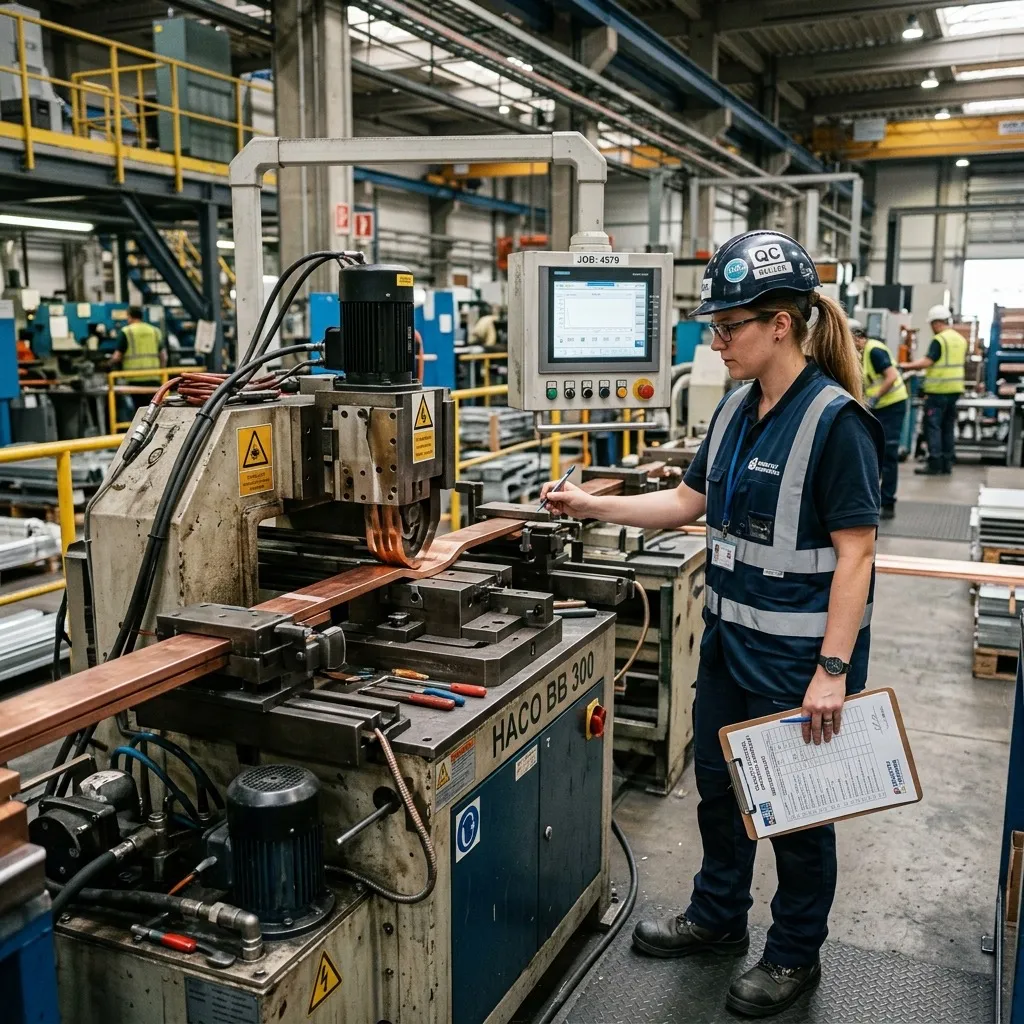
In 2025, an Australian machinery buyer lost $500,000 over the course of a year to a sophisticated scam orchestrated from a booth at the Canton Fair. The seller presented a polished corporate identity, a professional website, and a stack of ISO certificates. The contract started at $1 million and was inflated to $1.8 million through fabricated “supplementary fees”—customs bonds, export license surcharges, “priority production slot” premiums. The machines were delayed for nearly three years. When the buyer finally escalated, the seller had disappeared into a network of shell companies [1].
The same year, a procurement manager authorized a $412,840 payment based on a set of digital documents—certificates, inspection reports, factory photos—that looked legitimate. The containers arrived 41 days later with “rattling frames and mismatched welds.” The factory that actually produced those machines was not the one in the photos. An on-site visit would have cost approximately $12,000 and revealed the discrepancy in a single afternoon [2].
I work at a factory in Jinan, Shandong that builds CNC busbar machines. I want every buyer reading this to understand something: our industry has a verification problem, and it is getting worse as AI makes it easier to fabricate convincing digital evidence. The same company registration documents, ISO certificates, and factory tour videos that used to cost scammers real money to fake can now be generated with tools that are improving faster than most procurement teams’ verification protocols.
This article provides the verification framework that we have seen Fortune 500 procurement teams use successfully, adapted for the specific characteristics of CNC busbar machine manufacturing. It is what I would use if I were buying a machine from a factory I had never visited.
The Problem: Why Traditional Verification Methods Are Failing
The standard international procurement verification playbook—check the website, review the Alibaba Gold Supplier badge, verify ISO 9001, request references—was designed for an era when these signals were expensive to fake. They are no longer sufficient, for three reasons:
1. ISO 9001 certificates can be verified and still misleading. An ISO 9001 certificate confirms that the certified entity has a documented quality management system. It does not confirm that the entity is a manufacturer rather than a trading company, that it owns its production facility, that the equipment shown in marketing materials actually exists on its floor, or that the certificate’s scope covers the specific machine type you are purchasing. One case documented by Leeline Group found CNC machine cutting heads with severe wear, mandatory calibration stickers six months expired—and a maintenance binder that was “spotless” because the logs had been forged to pass a desk audit [3].
2. Alibaba and B2B platform badges are verification of payment, not verification of manufacturing capability. A “Gold Supplier” or “Verified Supplier” badge means the company paid the platform fee and submitted basic business registration documents. It does not mean the platform independently audited the factory floor.
3. AI-generated content is making digital-only verification dangerous. Factory photos, customer testimonials, even video walkthroughs can be synthesized or repurposed from other facilities. The only reliable verification methods in 2026 involve real-time, interactive, and ideally physical confirmation that the factory you are paying is the factory that will build your machine.
The 15-Point Factory Verification Protocol
This protocol is organized into four phases, from the free and quick to the paid and comprehensive. Every step you skip increases the probability that your machine’s quality will be determined by luck rather than diligence.
Phase 1: Document Verification (Free, 2-3 hours)
| # | Check | How to Execute | Red Flag |
|---|---|---|---|
| 1 | Business License | Request the unified social credit code. Verify it on China’s National Enterprise Credit Information Publicity System (NECIPS, gsxt.gov.cn). Check: (a) The registered business scope includes “manufacturing”, not just “trading”. (b) The registered capital is consistent with the claimed factory scale—a company claiming to operate a 10,000 m² factory with RMB 500,000 registered capital does not add up. (c) The registration date is consistent with the claimed company history. | Business scope is “trading” or “consulting.” Registered address is a virtual office or residential unit. |
| 2 | ISO 9001 Certificate | Request the certificate number and issuing body (e.g., SGS, TÜV, Bureau Veritas, CQC). Verify on the issuing body’s certificate database. Confirm: (a) The certificate is registered to the same company name and address as the business license. (b) The scope explicitly covers manufacturing of the machine type you are purchasing. (c) The certificate is current (not expired, not suspended). | Certificate registered to a different company name. Expired or suspended. Issued by an obscure certification body with no international recognition. |
| 3 | Export License and Customs Registration | Request the Customs Registration Code. A legitimate exporter must be registered with China Customs. Verify with the supplier’s freight forwarder that the exporter of record matches the manufacturer. | No customs registration provided. Exporter of record is a different company in a different city. |
| 4 | Factory Ownership or Lease Documentation | Request property ownership certificates or a long-term commercial lease for the claimed manufacturing address. Cross-reference the address with the business license. | Address mismatch. Short-term lease (under 2 years). “Virtual factory” registration address. |
| 5 | Component Supply Chain Documentation | Request purchase invoices or supplier agreements for the key components claimed in the quotation: PLC brand (Siemens, Beckhoff), linear guides (HIWIN, THK), bearings (NSK, SKF), hydraulic valves (Rexroth, Parker). A manufacturer that genuinely uses these components has purchase records. | ”Confidential supply chain” excuses. Inability to produce any component purchase documentation. |
Phase 1 Pass Threshold: All five documents verified with no red flags. If any document cannot be produced or contains discrepancies, escalate to Phase 2 before proceeding.
Phase 2: Live Interactive Verification (Free, 1-2 hours)
| # | Check | How to Execute | Red Flag |
|---|---|---|---|
| 6 | Live Video Factory Walkthrough | Schedule an unscripted video call. Ask the contact to walk through the production floor using a smartphone—not a pre-recorded tour, not a stationary camera. Request to see: (a) Machines in various stages of assembly (frames being cast or machined, control cabinets being wired, finished machines being tested). (b) The specific machine model you are purchasing, with at least 3-5 units visible on the floor. (c) Close-up of a PLC cabinet interior on an in-progress machine—brand labels on the PLC, contactors, and servo drives should be visible and legible. (d) The hydraulic pump configuration—count the pumps and verify they match the quotation’s specification. | Pre-recorded video passed off as live. Refusal to show cabinet interiors or component labels. Only finished/packed machines visible (may be reselling another factory’s production). Factory floor is suspiciously empty or clean for the claimed production volume. |
| 7 | Serial Number and Traceability Check | Ask the contact to show serial number plates on 2-3 in-progress machines. A legitimate manufacturer assigns sequential serial numbers to every machine. Compare the serial numbers to the claimed annual production volume—a factory claiming to ship 200+ machines per year should show serial numbers in a range consistent with that volume. | No serial number plates. Non-sequential or obviously fabricated numbers. The same serial number appears on multiple “different” machines. |
| 8 | Real-Time Machine Operation Demonstration | Ask the contact to load a sample copper busbar into a completed machine and run a punching or bending cycle. Observe: (a) The machine operates smoothly without unusual vibration or noise. (b) The HMI displays the expected control interface (Siemens, Beckhoff, or the specified brand). (c) The busbar after processing shows clean punch holes without burrs, and bend angles appear consistent. | Machine “currently undergoing maintenance.” “No copper bar available right now.” Machine appears to be a static display unit. |
| 9 | Engineering Team Introduction | Ask to speak briefly with the chief engineer or a senior technician—not the salesperson. Ask one technical question relevant to your application: “How do you handle springback compensation when bending hard-temper vs. soft-temper T2 copper?” or “What is your recommended punch-to-die clearance for 10mm T2 copper at Φ13mm hole diameter?” A manufacturer with in-house engineering expertise answers these questions immediately. A trading company deflects or gives a generic response. | Salesperson cannot produce an engineer. Engineer cannot answer basic technical questions about busbar processing. Engineer is clearly reading from a script. |
| 10 | Reference Customer Verification | Request contact information for 2-3 customers in your region who purchased the same machine model within the past 12 months. Contact these references directly. Ask: (a) Did the machine arrive on schedule and match the specification? (b) How was the commissioning and training experience? (c) Have you needed after-sales support, and how was the response? (d) Would you buy from this manufacturer again? | No references available. References are all in markets far from yours (makes independent verification difficult). References are uncontactable or give scripted responses. |
Phase 2 Pass Threshold: All five interactive checks completed with consistent, verifiable results. The live video walkthrough is the single highest-value verification step—a factory that passes #6-8 is almost certainly a legitimate manufacturer.
Phase 3: Independent Third-Party Audit (Paid, $440-1,500, 3-5 business days)
| # | Check | How to Execute | Cost |
|---|---|---|---|
| 11 | Comprehensive Factory Audit | Commission an independent inspection firm to conduct a physical on-site audit. Major firms: SGS ($300-600/man-day), Bureau Veritas (custom quote), TÜV Rheinland (custom quote). Mid-range alternatives: V-Trust ($498 factory audit), Tetra Inspection ($440 factory audit). The audit should cover: quality management system implementation (not just certification), production capacity verification, equipment maintenance and calibration records, raw material traceability, in-process quality control procedures, and finished product testing protocols. | $440-1,500 (depending on depth and provider) |
| 12 | Pre-Shipment Inspection | After your machine is manufactured but before it is crated, commission a pre-shipment inspection. The inspector should verify: the machine matches the specification in the purchase contract, all specified components are present and genuine, the machine operates correctly on a test busbar, surface finish and build quality meet expectations, and the crating meets export packaging standards. | $268-300/man-day (typical inspection firms) |
| 13 | Factory Acceptance Test (FAT) Attendance | If the machine value exceeds $20,000, strongly consider traveling to the factory for the FAT or sending a representative. The FAT should include: running your actual busbar drawings through the machine, measuring accuracy (hole pitch, bend angles) with calibrated instruments, verifying all specified components by brand and model, and confirming voltage/frequency configuration matches your grid. Budget $2,000-4,000 for flights and 3-4 days in Jinan. Compare this to the cost of receiving a machine that does not meet specification: a $412,000 mistake was prevented by a $12,000 on-site visit [2]. | $2,000-4,000 (travel + accommodation) |
Phase 3 Recommendation: For machines under $10,000, Phases 1-2 are typically sufficient. For machines $10,000-30,000, add the factory audit (#11). For machines over $30,000 or custom configurations, the FAT (#13) is strongly recommended—the cost of travel is an insurance premium against the cost of receiving a non-conforming machine.
Phase 4: Contractual Protection (Free, integrated into purchase process)
| # | Check | How to Execute | Red Flag |
|---|---|---|---|
| 14 | Contractual Quality Guarantees | The purchase contract should specify: (a) Exact component brands and model numbers for PLC, servo drives, linear guides, bearings, hydraulic valves, and motors—not just categories. (b) Performance guarantees: punching accuracy (±X.XX mm), bending accuracy (±X.X°), maximum throughput (HPM or pieces/hour). (c) Acceptance criteria: what measurements constitute a passed FAT, and the buyer’s right to reject if criteria are not met. (d) Penalty clause: if delivery exceeds the agreed timeline by more than X days, the deposit is refundable. | Supplier resists specifying exact component models. “Trust us on quality” language. No acceptance criteria defined. |
| 15 | Payment Structure with Inspection Gates | Structure payment as follows: (a) 30% deposit against proforma invoice—after Phases 1-2 verification is complete. (b) 40% after FAT is passed (either by your representative or a commissioned third-party inspector). This payment gate ensures the machine exists and meets specification before the majority of funds are transferred. (c) 30% before shipment, against video confirmation of crating and shipping documents. Avoid payment structures that require large balances before any independent verification has occurred. | Demands for large upfront payments before any inspection. Refusal to structure payments with FAT-linked milestones. Payment to personal or offshore accounts. |
Contractual Protection Note: The payment structure is your strongest leverage. A supplier who resists inspection-linked payment milestones is either a trading company that cannot control production quality, or a manufacturer whose quality process they do not want observed. In either case, walk away.
What a Legitimate CNC Busbar Machine Factory Looks Like
To calibrate your expectations, here is what you should see when you visit—or commission an audit of—a genuine CNC busbar machine manufacturer:
-
A dedicated manufacturing facility, not a shared office or rented warehouse space. The facility should be at least 2,000-5,000 m² for a manufacturer producing 100+ machines annually. DH CNC’s factory in Jinan spans over 4,000 m² with dedicated casting, machining, assembly, electrical wiring, and testing zones.
-
Machines in progressive stages of assembly. You should see cast-iron frames being stress-relieved, frames being machined on CNC milling centers, hydraulic systems being plumbed, control cabinets being wired, and finished machines undergoing burn-in testing. A factory floor with only finished machines is a showroom, not a production facility.
-
Component inventory that matches the specification. If the quotation promises Siemens PLCs and HIWIN linear guides, those branded boxes should be visible in the component stores area. A manufacturer that genuinely buys these components has them on the shelf.
-
A calibration and testing area. Every legitimate CNC machine manufacturer has a designated area where finished machines run test cycles with measurement instruments verifying accuracy. At DH CNC, every LATAM-bound machine undergoes a 72-hour burn-in test at the destination grid’s exact voltage and frequency before crating—and we can show you the test logs with serial numbers, dates, and measured values.
-
An engineering team, not just a sales team. The person who can answer detailed technical questions about hydraulic circuit design, PLC programming, and springback compensation algorithms should be reachable during the verification process.
If you are evaluating DH CNC as a potential supplier, we invite you to run this entire protocol against us. Send an email to [email protected] requesting our business license, ISO certificate, factory address, and a live video walkthrough. We will schedule the call within 48 hours. If you prefer a third-party audit, we will coordinate access for SGS, Bureau Veritas, TÜV, or any accredited inspection firm you select.
We built our factory to be audited. The companies that resist audits are the ones whose factories were built to be photographed, not inspected.
Related Resources
- How to Import a CNC Busbar Machine from China — Procurement Guide — Pillar reference: verification, duties, shipping, commissioning
- How to Finance Your CNC Busbar Machine Purchase — Equipment loans, Section 179, L/C structures, SinoSure
- About DH CNC Busbar Machine Factory — ISO 9001 certified, 15+ years heritage, monoblock frame manufacturing
References
[1] REPA Sourcing, “The $500,000 Long Game: How a Sophisticated Machinery Scam Works—and How to Kill It Before It Kills Your Business,” 2025. https://repasourcing.com/case-study/the-500000-long-game-how-a-sophisticated-machinery-scam-works-and-how-to-kill-it-before-it-kills-your-business/
[2] Speralto, “I Stopped Trusting Digital Audits the Day a PDF Cost Me $412,000,” 2025. https://speralto.com/41363-i-stopped-trusting-digital-audits-the-day-a-pdf-cost-me-412000-41/
[3] Leeline Group, “Factory Audit Checklist: What ISO 9001 Doesn’t Catch,” 2025. https://www.leelinegroup.com/factory-audit-checklist/
[4] QC Advisor, “Factory Audit in China: Quality Management System (QMS) Audit Guide,” 2025. https://www.qcadvisor.com/blog/factory-audit-china/
[5] TradeAiders, “SGS Pre-Shipment Inspection Alternatives: 6 Options That Cost Less,” 2026. https://www.tradeaiders.com/sgs-pre-shipment-inspection-alternatives-6-options-that-cost-less-honest-comparison.html
[6] Testcoo, “List of Best Inspection Companies in China,” 2026. https://www.testcoo.com/en/blog/list-of-best-inspection-company-in-china
[7] DH CNC, “China CNC Busbar Machine Factory Audit 2026 Checklist,” cncbusbarmac.com, July 2026. https://cncbusbarmac.com/blog/china-cnc-busbar-machine-factory-audit-2026-checklist/
Frequently Asked Questions (FAQs)
How can I verify a Chinese CNC busbar machine manufacturer is legitimate before placing an order?
A legitimate manufacturer should pass a 15-point verification protocol covering: (1) business license verification — request the unified social credit code and verify it on the National Enterprise Credit Information Publicity System (NECIPS). The code should trace to a manufacturing entity with the correct registered capital and business scope, not a trading company. (2) Factory ownership — request property ownership documents or a long-term lease. Be wary of shared office addresses in city centers or virtual office services. (3) ISO 9001 certificate verification — the certificate must be registered to the manufacturer's own company name and physical address, not a shell. Verify the certifier, expiry date, and scope on the issuing body's website. (4) Live video walkthrough — a real-time video call (not pre-recorded) walking through the production floor. Look for: machines in various stages of assembly (not just finished units), serial number plates on in-progress machines matching the claimed production volume, component brand labels visible on PLC cabinets (Siemens, Schneider, HIWIN, etc.), and at least 3-5 machines of the model you are purchasing visible on the floor. (5) Third-party factory audit — commission an independent inspection firm (SGS, Bureau Veritas, TÜV, or V-Trust) to conduct a physical on-site audit. A comprehensive factory audit costs $440-500 per man-day in China, and the report will verify production capacity, quality management system implementation, equipment calibration status, and material traceability.
What are the warning signs of a scam CNC busbar machine supplier on Alibaba or Made-in-China?
Seven red flags: (1) The supplier's business license shows them as a 'trading company' not a 'manufacturing company'. Trading companies resell machines from unknown factories without quality control. (2) The factory address on the business license does not match the address shown in video calls or street-view imagery. (3) Component brands in the quotation are vaguely described ('famous brand PLC,' 'Germany technology') rather than specifying exact model numbers (e.g., Siemens S7-1200 CPU 1214C). (4) The price is 30-50% below the market range for comparable machines with the claimed component specifications. A Siemens PLC alone costs the manufacturer $1,500-2,500 — a machine sold for $5,000 claiming Siemens controls is either using counterfeit components or will substitute them after order confirmation. (5) The supplier cannot provide references from customers in your region who purchased the same machine model within the past 12 months. (6) Payment is requested to a personal account, a Hong Kong shell company, or an account in a name different from the company on the proforma invoice. (7) The supplier resists or makes excuses for a third-party factory audit or live video walkthrough. Legitimate manufacturers welcome inspection — it closes sales.
DH303-8P 3-in-1 CNC Busbar Processing Machine
Discover details, parameters, standard dies packages, and factory quotes.